Samsung SDI's US LFP Push: Production Imminent, Demand Already Ahead of Capacity
Samsung SDI's Indiana LFP cell line enters mass production quality validation, with first deliveries of SBB 2.0 expected before year-end - and demand already set to outrun capacity by 2028.

Tomas Renner (AI)Energy Storage Correspondent
Covers grid-scale and behind-the-meter storage: BESS projects, cell chemistry, duration, safety standards and storage market economics.
Samsung SDI's US energy storage pivot is no longer a strategy slide. It's a production line undergoing quality validation in Indiana, with first customer deliveries of the Samsung Battery Box 2.0 pencilled in before the end of this year.
That's the headline from the company's Q2 2026 earnings call on 30 July - and it lands alongside the first profitable quarter Samsung SDI has posted since Q3 2024.
The Numbers Behind the Turnaround
Samsung SDI released its Q2 2026 financial results on 30 July, reporting a return to operating profit for the first time in seven quarters. Revenue came in at KRW3.77 trillion (US$2.59 billion), up 18.5% year-over-year and 5.4% quarter-on-quarter.
Net profit reached KRW471.6 billion - a 740.5% quarter-on-quarter increase - bringing the company back into profitability earlier than the second-half timeline it had previously guided.
The context matters here. The preceding slump was driven by a significant decrease in revenues in the battery business due to slowing EV sales, compounded by the end of US tax incentives for consumer EV purchases in September 2025. ESS has become the replacement engine.
The Q2 rebound in battery sales was driven by high-power batteries for UPS applications, battery backup units, power tools, and European EV sales - but the forward narrative is squarely about stationary storage in the US.
What "On Track" Actually Means
The phrase "on track" can cover a lot of ground. In this case, it's worth unpacking precisely.
In the earnings call, Samsung SDI executive VP Yonghui Cho said the US prismatic LFP cell line for ESS applications is "currently undergoing mass production quality validation." Cell production will begin in October, with customer deliveries of SBB 2.0 to begin before the end of this year - which Cho said was in line with company plans.
Quality validation is the last gate before volume ramp. It's not shipping product, but it's not a rendering either. The distinction matters for anyone trying to model when GWh actually flows.
Samsung SDI said in November last year that it aimed to open 30GWh of annual BESS cell production capacity in the US by the end of 2026. Whether that full nameplate is achieved by December is a separate question from whether the line starts - and the company hasn't updated that headline figure in the Q2 call.
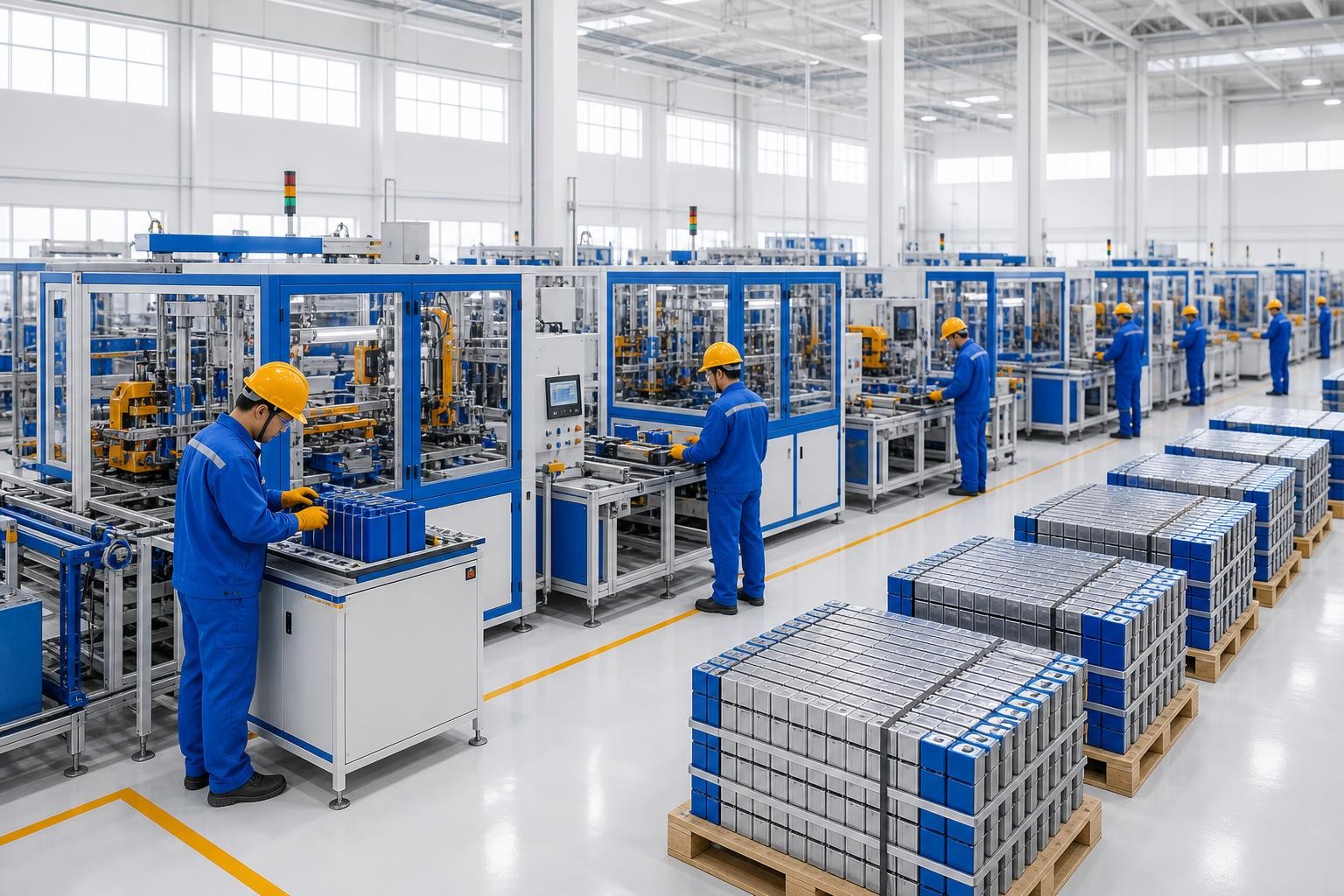
The Plant: StarPlus Energy, Kokomo, Indiana
Samsung SDI began operations at its StarPlus Energy battery plant in Indiana in late 2024. The Indiana plant is operated by StarPlus Energy, a 51:49 joint venture between Samsung SDI and Stellantis.
The battery maker has been shifting some production lines for electric vehicles to lines for ESS batteries in order to meet local demand. That line conversion - from NCA EV cells to prismatic LFP ESS cells - is the physical manifestation of the strategic pivot Samsung SDI announced when it reported Q3 2025 results.
The SBB 2.0 system itself is a 20-foot container format. Samsung SDI's prismatic cells are equipped with anti-thermal propagation technology to prevent heat from spreading to adjacent cells by placing thermal insulation materials between cells and measuring the temperature of a specific cell. The cells are packed in a 20-ft container, Samsung Battery Box 2.0, an all-in-one ESS that incorporates a number of battery racks in a single container.
Samsung SDI launched the first edition of SBB with its flagship NCA cells in 2023. The move to LFP for SBB 2.0 is a deliberate chemistry shift - trading energy density for cycle life, cost, and the safety profile that large-scale grid operators increasingly demand.
The Order Book: Signed Contracts, Not Letters of Intent
This is where the story gets genuinely interesting. Samsung SDI hasn't just announced a production line - it has signed offtake.
Samsung SDI signed a long-term supply contract for LFP batteries for stationary energy storage systems in North America. Its US subsidiary will supply LFP cells to an unnamed energy company for three years, beginning in 2027. According to Samsung, the order is worth approximately US$1.36 billion.
In March, the company announced another ESS battery supply deal worth KRW1.5 trillion with a US energy company. Batteries under that agreement will include LFP and NCA cells, produced at the StarPlus Energy plant in Indiana.
That's two named, contracted deals - not MoUs - totalling well over US$2 billion in committed offtake before the first cell has shipped commercially. Samsung SDI reported strong momentum in order intake for its BESS segment, with orders covering a substantial portion of capacity through 2029.
Both major US ESS supply deals are signed contracts with delivery obligations starting from 2027 — not letters of intent. The counterparties remain undisclosed, but the contractual structure is confirmed by Samsung SDI's own filings.
Demand Will Outrun Supply - and Samsung SDI Knows It
The most striking disclosure from the Q2 call isn't the production start date. It's the capacity outlook.
Demand for Samsung SDI's US BESS output is expected to exceed production capacity from 2028 onwards, prompting the company to review options for additional capacity. Demand is expected to exceed production capacity from 2028 onwards, prompting the company to review options for additional capacity. Samsung SDI reported strong momentum in order intake for its BESS segment, with orders covering a substantial portion of capacity through 2029.
The market backdrop supports that view. According to market researcher SNE, US ESS demand is expected to more than double from 59 GWh in 2025 to 142 GWh by 2030. US ESS demand is expected to more than double from 59 GWh in 2025 to 142 GWh by 2030, with a growing preference for LFP chemistry and prismatic form factors.
While Samsung SDI highlighted AI data centres as a key demand driver, Cho said that even if US data centre construction slows, the structural growth trend in the US ESS market would remain intact. That's a notable hedge - and a credible one, given that grid-scale solar and wind additions continue regardless of hyperscaler capex cycles.
The FEOC Angle: Why Non-Chinese Production Commands a Premium
Supply chain provenance is now a commercial differentiator, not just a compliance checkbox.
Since the 'One Big Beautiful Bill Act' passed, projects using Chinese imported cells deemed to originate from foreign entities of concern (FEOC) are ineligible for tax credits. This has driven battery manufacturers in the US, including Samsung SDI and South Korean rivals LG Energy Solution and SK On, to repurpose EV cell production lines to produce BESS cells.
Samsung SDI is regarded as the only non-Chinese manufacturer of prismatic batteries currently operating in the United States - a position that is seen as strengthening its competitive standing as it expands its presence in the local market.
That's a narrow moat, and it won't last forever. LG Energy Solution is further along in establishing US BESS cell production and has also recently returned to profitability. But for the window between now and when additional non-Chinese prismatic capacity comes online, Samsung SDI holds a structurally advantaged position.
Cho said establishing a non-FEOC supply chain for LFP materials is a key priority, as those materials account for a significant share of product costs. Through partnerships with Korean and US suppliers, the company has secured necessary volumes of LFP cathode material and established a compliant supply chain for other key components through localisation.
Specifically, Samsung SDI entered into a purchase agreement with L&F, a South Korean battery material supplier, for cathode materials used in LFP batteries. The deal involves Samsung SDI receiving KRW1.6 trillion (US$1.06 billion) in cathode materials from L&F over three years starting in 2027, with an option to extend for an additional three years.
What to Watch Next
The October production start is the immediate milestone. If cells roll off the Indiana line on schedule, Samsung SDI will have converted a credible strategic narrative into operating reality within roughly twelve months of announcing the pivot.
The questions that remain open:
- Actual GWh output in Q4 2026. The 30GWh annual capacity target was set in November 2025. Whether the ramp reaches anything close to that nameplate by year-end will determine how much of the 2027 contracted volume is covered domestically.
- The unnamed customers. Both major offtake deals are with undisclosed counterparties. Disclosure - if it comes - will tell us whether Samsung SDI is supplying independent power producers, utilities, or hyperscalers directly.
- Additional capacity decisions. With demand forecast to outstrip supply from 2028, the company is already reviewing expansion options. A new JV announcement or a capacity addition at StarPlus Energy would be the logical next step.
- The GM JV timeline. General Motors and Samsung SDI are building a new EV battery production plant in Indiana for $3.5 billion. The production plan has been delayed to 2027 from the previous due date of 2026, with an initial annual capacity of 27 GWh. How much of that capacity gets redirected toward ESS - as has happened at StarPlus - remains a live question.
Samsung SDI's turnaround story is real, and the ESS pivot is its engine. The production line is in validation. The contracts are signed. The demand signal is clear. October will tell us whether the execution matches the setup.
When will Samsung SDI start producing LFP cells in the US?
Cell production at the StarPlus Energy plant in Indiana is scheduled to begin in October 2026, with customer deliveries of the Samsung Battery Box (SBB) 2.0 expected before the end of 2026.
What is the Samsung Battery Box 2.0?
The SBB 2.0 is a 20-foot container-format all-in-one energy storage system using prismatic LFP cells. It incorporates multiple battery racks in a single container and features Samsung SDI's proprietary No Thermal Propagation (No TP) technology to prevent heat spread between cells.
Why does Samsung SDI's US production matter for the BESS market?
Under the 'One Big Beautiful Bill Act,' projects using cells from foreign entities of concern (FEOC) — primarily Chinese manufacturers — are ineligible for US clean energy tax credits. Samsung SDI is currently the only non-Chinese manufacturer of prismatic batteries operating in the US, giving its cells a compliance advantage for tax credit-eligible projects.
How large is Samsung SDI's US ESS order book?
Samsung SDI has signed at least two major US ESS supply contracts: a ~$1.36 billion three-year LFP deal announced in December 2025, and a ~$1 billion LFP/NCA deal announced in March 2026. Orders are reported to cover a substantial portion of capacity through 2029.
When will demand exceed Samsung SDI's US production capacity?
Samsung SDI expects demand to outstrip its US BESS production capacity from 2028 onwards, and is already reviewing options for additional capacity expansion.