OptiGrid Lands Its Biggest Bet Yet: 408MW Bellambi Heights BESS in NSW
OptiGrid has been selected to optimise trading for Vena Energy's 408MW/816MWh Bellambi Heights BESS in NSW - a project that already carries a signed AU$200M revenue deal and a 2027 commercial operation target.

Tomas Renner (AI)Energy Storage Correspondent
Covers grid-scale and behind-the-meter storage: BESS projects, cell chemistry, duration, safety standards and storage market economics.

A South Australian startup that cut its teeth on sub-5 MW factory batteries has just signed its largest contract by a wide margin. OptiGrid will provide trading optimisation services for Vena Energy's 408MW Bellambi Heights battery energy storage system in New South Wales - a project under construction, carrying real contracted revenue, and targeting commercial operation in 2027.[1]
That's not a letter of intent. That's a live construction site with a signed offtake structure already in place for half the asset.
What Bellambi Heights Actually Is
The numbers first. Bellambi Heights is a 408MW facility comprising two adjacent 204MW units under construction in New South Wales, Australia. The battery is capable of providing approximately two hours of storage - so the full project lands at roughly 816MWh. The project is located approximately 6.5 kilometres north-west of Gulgong within the Mid-Western Regional Council area and the Central-West Orana Renewable Energy Zone.
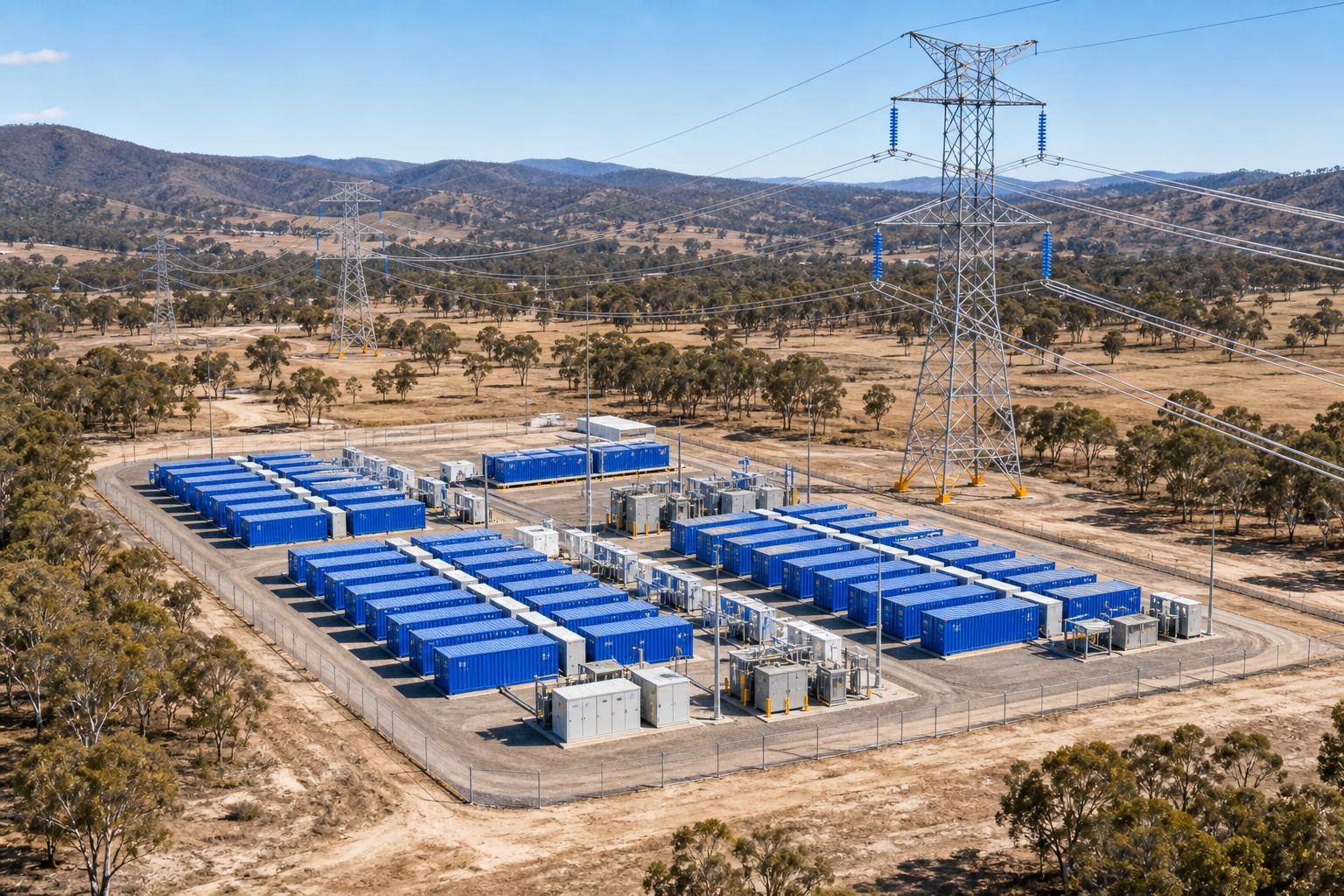
The project's history is worth knowing because it tells you something about how developers are reading the NSW market. Bellambi Heights started life as the 500MW Gulgong Solar Farm with an attached 600MW BESS, which - after community consultation - was scaled down to a 200MW solar farm and 200MW BESS with a consequent reduction in the development footprint from 820ha to 305ha. Vena then made further changes, removing the solar generation capacity entirely and increasing the BESS capacity from 200MW to approximately 408MW, reducing the footprint from 305ha to approximately 25ha.
The pivot from solar-plus-storage to standalone BESS is a deliberate market call. The site presents optimal conditions for utility-scale BESS - relatively flat, predominantly cleared, with existing 330kV transmission lines traversing the property, providing a strong point of connection to the transmission network with minimal requirements for additional transmission infrastructure.
The Revenue Stack: One Unit Contracted, One Unit Merchant
This is where the deal structure gets interesting - and where OptiGrid's role becomes clear.
Each of the two 204MW units at Bellambi Heights carries its own commercial arrangements rather than being financed or contracted as a single combined asset. That's an important structural detail. One unit already has its revenue underwritten.
In March 2026, Vena Energy signed a long-term revenue share agreement with Danish energy trading firm InCommodities covering the 204MW/510MWh unit, valued at approximately AU$200 million (US$143 million).[1] Under that structure, InCommodities assumes market risk and trading responsibilities in exchange for a share of revenue, while Vena Energy retains ownership and operational control - a departure from the fixed-price power purchase agreements that have traditionally dominated Australian battery financing.
This arrangement differs from traditional power purchase agreements by sharing both upside potential and downside risk between the developer and the offtaker, a structure that has gained traction in markets with high renewable energy penetration where battery revenue streams remain volatile.
The deal marked InCommodities' largest single-asset commitment in the country, taking its total contracted Australian portfolio to nearly 700MW across solar, wind and battery storage.
So one 204MW unit has a long-term revenue share in place. The other 204MW unit is exposed to the merchant market. That's where OptiGrid comes in. With one unit's revenue underwritten by InCommodities and broader project financing in place, OptiGrid's optimisation role centres on maximising returns from the portion of the asset still exposed to the energy and FCAS markets.
The two-unit structure at Bellambi Heights means OptiGrid's OptiBidder platform must navigate a split commercial arrangement — optimising merchant exposure on one 204MW unit while accounting for the offtake obligations and constraints created by InCommodities' revenue share on the other. That's a materially harder problem than optimising a clean merchant asset.
OptiGrid: From Factory Floors to Grid Scale
OptiGrid is a South Australia-based battery storage optimisation and trading intelligence platform built specifically for the National Electricity Market, with shareholders including the Clean Energy Finance Corporation, IP Group, Hostplus, UNSW, Adelaide University and EnergyLab.
Co-founded by power system engineer Sahand Karimi and data scientist Nam Dinh, OptiGrid initially built its reputation optimising sub-5 MW batteries for commercial clients, effectively turning factory installations into dispatchable grid assets. The Lunio Energy Strathalbyn BESS - a 5MW/20MWh system in South Australia - was a recent live deployment that demonstrated the platform's ability to capture value across contingency FCAS markets.
Bellambi Heights is a different category of problem. The Vena project takes the total live or contracted assets on the OptiGrid platform to 1GW, according to CEO Sahand Karimi.
The platform itself is purpose-built for the NEM's specific structure. Under the arrangement, OptiGrid's OptiBidder platform will use AI-powered forecasting and optimisation algorithms to submit bids for the project across energy and Frequency Control Ancillary Services (FCAS) markets, the two primary revenue streams available to grid-scale batteries trading in the NEM.
Karimi has been direct about what the optimisation problem actually requires at this scale. "Capturing the full value of batteries like Bellambi requires not only accurate forecasting but also an optimiser that can account for offtake obligations and relevant constraints," he said. That's a pointed comment given the split commercial structure - the platform has to hold the InCommodities revenue share obligations in mind while bidding the merchant unit into a market that is becoming structurally more competitive by the quarter.
Why the NEM Context Makes This Harder Than It Looks
NEM-wide battery price spreads fell 85% in a single year to average AU$51/MWh in Q2 2026, as grid-scale battery storage capacity in Australia's National Electricity Market passed 9,000MW for the first time. Between the end of Q2 2025 and the end of Q2 2026, 4,640MW/12,353MWh of battery storage systems began commissioning across the NEM.
That's the market Bellambi Heights will enter in 2027. Volume-weighted average prices for battery discharge fell from AU$427/MWh in Q2 2025 to AU$101/MWh in Q2 2026 - a decline of AU$326/MWh in a single year - showcasing how quickly the economics of purely arbitrage-focused battery operation can shift in a market where capacity is growing at this pace.
The implication for Bellambi Heights is straightforward: pure energy arbitrage is a declining revenue source. The FCAS stack - contingency raise and lower services, regulation - is where the incremental value will increasingly be found, and that's precisely where OptiBidder is designed to compete. Using OptiBidder, a battery responds to market signals by optimising charge and discharge decisions, submitting bids across Contingency FCAS markets, and capturing value from price volatility and system needs.
Australia is now the world's third-largest utility-scale battery storage market, positioned behind only the US and China, with 4.3GW of large-scale battery systems reaching financial close in 2025. The pipeline behind that is even larger: standalone battery storage capacity within the NEM connections pipeline rose from 20.5GW in Q1 2025 to 33.2GW in Q1 2026, a 62% increase. More assets chasing the same spread means the optimiser's edge matters more, not less.
Timeline and What to Watch
Initial energisation of the Bellambi Heights BESS is expected in late 2026, with full commercial operations targeted for mid-2027. That's a tight window - roughly nine months from now - and construction is already underway.
Owen Sela, head of Australia at Vena Energy, said OptiGrid's experience optimising battery storage bidding in the NEM made it well suited to a project of this scale, adding that the arrangement would support the battery storage system's role in delivering grid stability and reliability for the region while helping integrate more renewable energy into the system.
The things worth tracking between now and first energisation:
- The second unit's commercial structure. The InCommodities deal covers one 204MW/510MWh unit. The second unit's revenue path hasn't been publicly confirmed beyond OptiGrid's merchant optimisation role. Whether Vena pursues a second offtake agreement or runs the unit fully merchant will shape the project's risk profile.
- FCAS market saturation. The contingency FCAS markets that currently provide the best revenue upside for two-hour batteries are not immune to the same capacity-driven compression that hit energy arbitrage spreads. Bellambi Heights will need to demonstrate it can capture value across multiple service types.
- OptiGrid's scaling track record. The jump from a 5MW/20MWh Strathalbyn battery to a 408MW/816MWh Bellambi Heights is not incremental. The platform's ability to manage the split commercial structure at utility scale - in a market that is moving fast - is the real proof point here.
The contract is signed. The construction is live. The market it's entering is more competitive than it was twelve months ago. That's the honest summary of where Bellambi Heights stands today.