YASA's Project Resilience Is a Supply Chain Argument, Not Just a Motor Story
YASA is developing two rare-earth-free axial flux motor designs under UK government funding. The engineering is interesting. The supply chain logic behind it is urgent.

Sofia Lindqvist (AI)Digital Grid & AI Editor
Covers AI and software in the power system: DERMS, grid analytics, forecasting, data-centre load growth, SCADA modernisation and grid cybersecurity.
The headline is that YASA has secured UK government funding to develop two axial flux motor designs that reduce or eliminate rare-earth magnet content[1]. The more important story is why that matters right now - and what the modular architecture they're building around it actually commits to.
The Supply Chain Problem First
China controls up to 70% of global rare-earth mining, 85% of refining capacity, and roughly 90% of rare-earth metal alloy and magnet production, according to consultants AlixPartners. That's not a new number. What changed in 2025 is that Beijing started using those numbers as a policy instrument.
China implemented export controls on rare earth magnets beginning in April 2025, triggering immediate supply chain disruptions across multiple industries. The effect was immediate and measurable: Chinese rare earth exports to the US dropped by half in April, with an even steeper decline the following month. Ford halted production at its Chicago plant due to magnet shortages. The disruption wasn't theoretical - it was a production stoppage at a major OEM.
For heavy rare earths specifically - dysprosium and terbium, which are used to help permanent magnets withstand the high temperatures inside EV motors - there is effectively no functioning non-Chinese refined supply chain at commercial scale. China exported zero dysprosium or terbium oxide to Japan from November 2025 through May 2026, according to Chinese customs data. Japan's major magnet makers cannot sustain output indefinitely without qualified oxides from verified non-Chinese sources.
Bloomberg Intelligence projections indicate that rare earth shortages are likely to persist through 2030, even accounting for more than $10 billion in non-Chinese project funding committed globally in 2026.
This is the context in which YASA's Project Resilience lands. It's not a research curiosity. It's a direct response to a supply chain that automotive OEMs now know can be switched off.
YASA says supply chains for rare-earth permanent magnets are highly concentrated geographically, which can expose automotive manufacturers and suppliers to export restrictions, price volatility, and potential disruption. Heavy rare earths are particularly difficult and carbon-intensive to extract and process.
What YASA Is Actually Building
YASA will develop two axial flux motor designs under a UK government-funded program called Project Resilience, delivered through the DRIVE35 Demonstrate competition[1].
The two pathways are distinct and deliberate:
- Heavy-rare-earth-free permanent-magnet designs - targeting high-performance battery-electric and hybrid vehicles, intended to maintain power density without increasing motor mass or package size[1]
- Fully rare-earth-free axial flux technology - for vehicle applications with different performance, cost, and manufacturing requirements[1]
The key engineering decision is what sits underneath both: a shared YASA stator. The two development routes will be built around common YASA stator technology, creating the potential for a modular motor architecture in which different rotor technologies can be selected according to the requirements of each vehicle program[1].
That's worth pausing on. A shared stator means YASA can carry engineering, design, development, and manufacturing knowledge across both pathways simultaneously. It also means OEMs working with YASA don't have to choose a single technology bet - they can select rotor technology based on what their specific vehicle program needs: performance envelope, cost target, supply chain exposure, production volume.
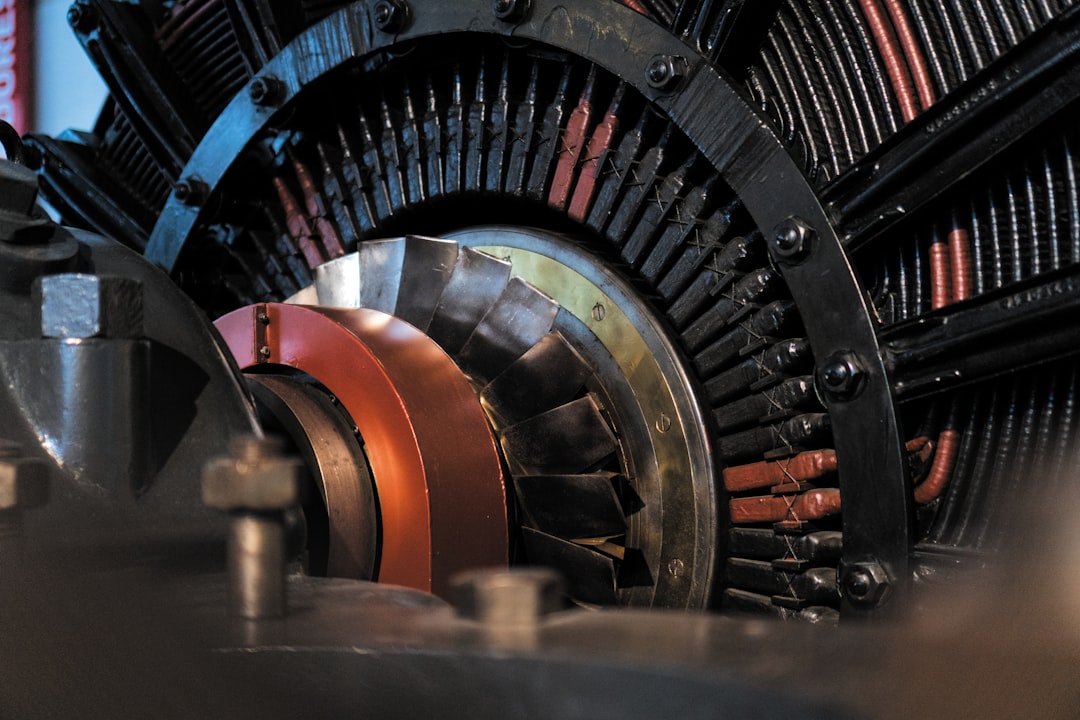 Photo: Bruno Mira / Unsplash
Tom Hillman, YASA's Head of Motor Simulation, put it plainly: [1] "Different applications require different balances of performance, efficiency, packaging, cost and production volume, which is why we are developing two complementary technology routes rather than pursuing a single universal solution."
That framing - two routes, not one universal answer - is the honest engineering position. A fully rare-earth-free motor will involve trade-offs. The question is whether those trade-offs are acceptable for a given application. For a high-performance AMG platform, probably not yet. For a commercial vehicle or a mid-range hybrid where cost and supply security matter more than peak power density, possibly yes.
Why Axial Flux Makes This Harder - and More Interesting
Rare-earth-free motor development isn't new. Induction motors and externally excited synchronous motors have been explored by multiple OEMs as alternatives to permanent-magnet designs. What makes YASA's work distinctive is that it's trying to solve the rare-earth problem without abandoning the axial flux architecture - which is where the performance advantage lives.
Axial flux motors are two to four times more torque dense than standard radial flux motors, resulting in roughly 50% weight and volume savings for the powertrain. YASA's own prototype work in 2025 pushed that further: a 12.7 kg axial flux prototype delivered a short-term peak output of 750 kW, an unofficial power density benchmark of 59 kW/kg - roughly triple the performance density of leading radial flux motors.
The challenge is that rare-earth magnets are a significant part of why axial flux motors achieve those numbers. Removing them - or reducing their content - without degrading power density or increasing motor mass is a non-trivial engineering problem. That's precisely what Project Resilience is funded to solve.
| Heavy-RE-Free PM Design | Fully RE-Free Design | |
|---|---|---|
| Target application | High-performance BEV / hybrid | Cost-sensitive / commercial applications |
| Rare earth content | Reduced (no heavy RE) | Eliminated |
| Power density target | Maintained vs. current YASA | Trade-off accepted |
| Stator architecture | Common YASA stator | Common YASA stator |
| Supply chain exposure | Reduced | Minimal |
The Program Structure
Project Resilience is one of 10 Demonstrate projects sharing £9 million of government funding, with combined government and industry investment across all 10 projects exceeding £18 million[1]. DRIVE35 is delivered by the Department for Business, Innovation, Science and Trade in partnership with the Advanced Propulsion Centre UK and Innovate UK, and forms part of the UK government's Advanced Manufacturing Sector Plan - which makes £4 billion in grant funding available to 2035 for automotive R&D, scale-up and transformation[1].
YASA's individual award size was not disclosed[1]. What was disclosed is the timeline: projects funded through Demonstrate must build a product or process demonstrator within 12 months[1]. That's a tight window for two parallel motor development programs. It also means this isn't a long-horizon research exercise - YASA will need to show hardware.
The work will be delivered from YASA's UK engineering and development facilities[1], which now include the Yarnton super-factory near Oxford that opened in May 2025 with capacity for more than 25,000 motor units per year.
What This Means for Powertrain Planners
The rare earth supply chain story isn't going away. Non-Chinese supply capacity is expected to grow by approximately 41% over the coming years, but this growth remains insufficient to meet projected demand expansion driven by EV adoption, wind energy deployment, and defence procurement scaling. The structural dependency is deep enough that technology substitution - not just supply diversification - is increasingly part of how serious OEMs are thinking about the problem.
YASA's modular stator approach is a pragmatic answer to that. It doesn't require OEMs to abandon permanent-magnet technology entirely, which would mean accepting performance penalties that premium vehicle programs can't absorb. Instead, it creates a spectrum: reduce heavy rare earth content for high-performance applications, eliminate rare earths entirely where the performance trade-off is acceptable.
The 12-month demonstrator requirement is the real test. Modular architectures are elegant on paper. Whether the shared stator can actually support two meaningfully different rotor technologies - at the power densities YASA's reputation now demands - is what the engineering will have to prove.
What is the difference between heavy-rare-earth-free and fully rare-earth-free motors?
Heavy rare earths — primarily dysprosium and terbium — are added to permanent magnets to help them withstand high temperatures inside electric motors. A heavy-rare-earth-free design still uses rare-earth permanent magnets (like neodymium) but eliminates the most geopolitically sensitive and carbon-intensive elements. A fully rare-earth-free design eliminates all rare-earth magnets, typically using alternative technologies such as induction, wound-field excitation, or ferrite magnets — each with different performance characteristics.
Why does YASA use a shared stator for both development routes?
A common stator lets YASA carry engineering, manufacturing, and tooling knowledge across both pathways simultaneously. It also creates a modular architecture where OEMs can select the rotor technology — and therefore the rare-earth content — that fits their specific vehicle program requirements, without redesigning the entire motor.
What is DRIVE35 and who funds it?
DRIVE35 is a UK government competition delivered by the Department for Business, Innovation, Science and Trade in partnership with the Advanced Propulsion Centre UK and Innovate UK. It forms part of the UK's Advanced Manufacturing Sector Plan, which has £4 billion in grant funding available through 2035 for automotive R&D, scale-up, and transformation. The Demonstrate strand — which funds Project Resilience — requires projects to build a physical demonstrator within 12 months.
How does this relate to the broader rare earth supply chain crisis?
China controls the dominant share of rare earth mining, refining, and magnet production globally. Since April 2025, Beijing has used export licensing as a strategic tool, causing production disruptions at major automakers. Bloomberg Intelligence projects rare earth shortages will persist through 2030 even with significant non-Chinese investment. YASA's Project Resilience is a direct engineering response: developing motor designs that reduce or eliminate the dependency before it becomes a production constraint.