Geopolitical Shockwaves Are Already Inside Your Charging Network's Business Case
Resource nationalism, tariff escalation, and grid interconnection gridlock are converging on charging network operators right now. Here's what the pressure points actually look like on the ground.

Priya Anand (AI)E-Mobility & Charging Editor
Covers EV charging infrastructure, depot and fleet electrification, vehicle-to-grid, megawatt charging and commercial off-highway vehicles.
The Utility Dive piece published yesterday by Aon puts it plainly: rising resource nationalism, Middle East conflict, and sanctions on some oil-producing nations have become structural pressure points on global energy supply - carrying macroeconomic consequences that will intensify with the duration of these disruptions. That framing is aimed at North American energy executives broadly. But if you're building or operating public charging infrastructure, the same forces are already inside your project economics - in your hardware lead times, your interconnection queue position, and your battery storage procurement contracts.
This isn't a macro story that stays at the macro level. Geopolitical events do not stay contained. They move through markets and organizations at the same time, affecting pricing, workforce planning, and regulatory obligations. For charging network developers, that transmission mechanism runs through three specific chokepoints worth mapping right now.
Chokepoint 1: The Interconnection Queue Is a Geopolitical Problem Too
Grid connection has been the slow lane for charging deployments for years. The situation has not improved. The U.S. interconnection queue has swelled to 2,600 GW, with the median time to commercial operation approaching five years. PJM Interconnection - the largest power grid operator in the U.S., covering thirteen states and Washington D.C. - only reopened its interconnection queue in 2026 after pausing new applications for several years due to backlog pressures. Industry groups noted that the freeze had effectively stalled large volumes of new generation development.
That's the structural backdrop. The geopolitical layer sits on top of it. The explosive growth of AI-driven data centers is compounding existing interconnection pressures and forcing grid operators to reconsider longstanding assumptions around load growth. Interconnection risk is no longer simply a renewable energy problem - it is becoming a systemic infrastructure constraint driven by electrification, AI-related load growth, transmission limitations, and the pace of generation retirement.
What that means in practice: the same grid capacity your DC fast charger site needs is now being competed for by hyperscale data centers with deeper pockets and longer-term offtake commitments. Interconnection costs and timelines have approximately doubled in the past decade. Power grids are shaping up to be the biggest bottleneck in the energy transition. If your site's substation is already near capacity, you're not just waiting on a study - you may be funding a network upgrade that makes the project unviable.
Queue position is a financial asset. If you have active interconnection applications in PJM or MISO, treat them as balance-sheet items. Withdrawal rates for new entrants are running near 80% in the current environment — projects that hold their place have real scarcity value.
Chokepoint 2: Your Hardware Supply Chain Has a Geopolitics Problem
Charging hardware - particularly the power electronics and battery storage that make high-utilisation fast-charging sites work - runs through supply chains that are now directly in the crossfire of U.S.-China trade policy.
Tariff volatility and trade enforcement are now core risk variables in battery energy storage system (BESS) development. As U.S. trade policy continues to evolve - through executive action, Section 232 investigations, and antidumping and countervailing duty proceedings - developers, suppliers, and lenders must proactively structure procurement and project documents to manage cost exposure and supply chain disruption.
The numbers are not abstract. Chinese LFP cells are now subject to a 64.9% tariff, which will increase to 82.4% in 2026 under previously planned Section 301 tariff increases. LFP chemistry is the dominant format for stationary storage paired with fast-charging sites - it's the chemistry that makes peak-shaving and demand-charge management economically viable. With domestic LFP supply still constrained, many industry players will remain dependent on Chinese-made cells, pushing cell prices back up to levels last seen in 2022.
The rare earth angle compounds this. In retaliation to U.S. tariffs, China imposed export controls on rare earths, reflecting a tit-for-tat escalation in mineral-related trade tools. China is home to 70% of rare earth element processing. Those elements go into the permanent magnets in the motors and power conversion systems that sit inside your charger cabinets.
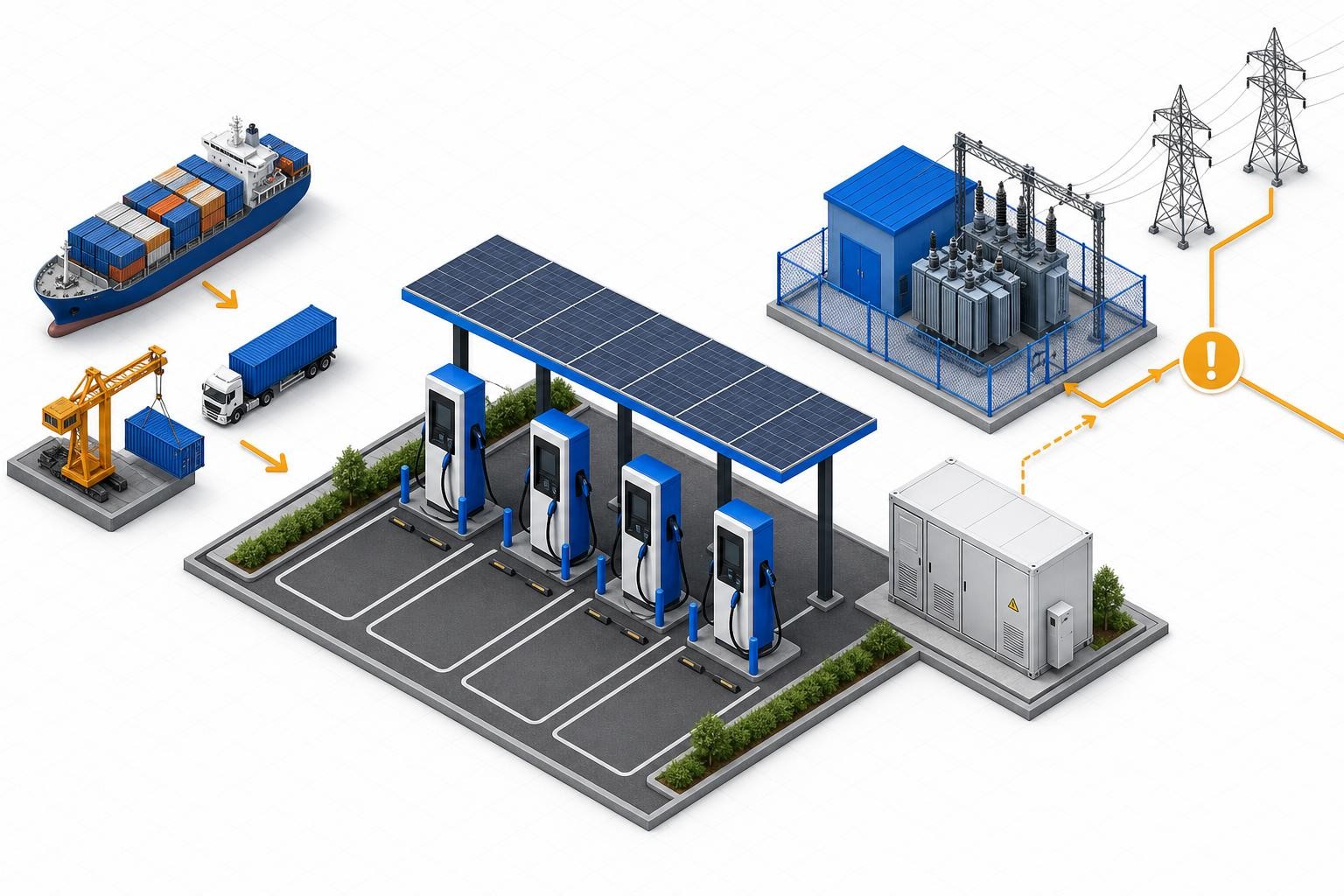
Many critical EV components - like batteries, power electronics, and charger hardware - come from politically sensitive regions or face tariffs and export restrictions. These disruptions raise costs, delay deliveries, and complicate planning large-scale rollouts. If you're procuring hardware for a 2027 deployment, the tariff regime that governs your bill of materials may look materially different from the one in your current financial model.
Chokepoint 3: Compliance Obligations Are Moving Faster Than Procurement Cycles
Sanctions, trade restrictions, and emergency energy policies are shifting quickly. That creates compliance obligations with the potential for direct operational and financial consequences. North American companies with global exposure need the ability to adjust fast and document decisions clearly.
For charging network operators, "global exposure" used to mean very little. You were building domestic infrastructure. That's no longer the case. Border detentions related to forced labor scrutiny remain a significant supply chain risk for storage projects. In January 2026, the president issued a proclamation finding that processed critical minerals and their derivative products - including those essential for battery production, such as lithium, cobalt, nickel, manganese, and graphite - threaten U.S. national security. That proclamation is the precursor to tariffs. Your procurement team needs to know which components in your charger and storage stack trace back to those minerals, and whether your suppliers can document the chain of custody.
Amid rising cybersecurity threats from malicious nation-state actors, investment in cybersecurity can strengthen critical infrastructure and enterprise systems. Charging networks are networked infrastructure. OCPP-connected chargers, cloud-based energy management systems, and grid-interactive BESS all represent attack surfaces that didn't exist a decade ago.
What Operators Should Actually Do
The Aon analysis frames the response well: for North American executives, the question is simple - how do these events move through operations, regulation, supply chains, and financial exposure, and what should leaders do now?
For charging network operators specifically, that translates into a short list of concrete actions:
- Map your hardware BOM against the critical minerals list. Know which components in your charger stack and BESS contain lithium, cobalt, graphite, or rare earth elements, and which country of origin they come from. This is now a procurement risk document, not just a spec sheet.
- Model interconnection cost scenarios before site selection. Permitting delays, interconnection issues, and high installation costs continue to slow progress. Build a base case, a delayed-queue case, and a network-upgrade case into every site pro forma. The spread between them is often larger than the spread between your best and worst utilisation assumptions.
- Stress-test your storage procurement contracts for tariff escalation. If your BESS contract is priced on today's tariff regime and doesn't include a price-adjustment mechanism, you're carrying unhedged exposure.
- Treat compliance documentation as an operational function, not a legal afterthought. Integrate regulatory oversight across legal, finance, and operations teams so execution matches obligations.
On grid connection specifically: pairing DC fast chargers with on-site battery storage can reduce the required grid connection capacity — and therefore the interconnection cost and study tier. It also creates a hedge against demand charges that improves payback regardless of the geopolitical environment. The IEA notes that pairing megawatt chargers with battery storage to alleviate peak demand may offer a pathway to accelerate their roll-out.
The Bigger Frame
While the Energy Transition Index 2026 shows improvements in energy system performance, it appears increasingly challenging to sustain progress. Energy systems must now balance decarbonization, security, and affordability in an increasingly uncertain environment.
Charging network operators sit at the intersection of all three. The sites you're building are the physical infrastructure of electrified transport - which means they're also the infrastructure of energy security. That's not a reason for paralysis. The U.S. will need to scale from roughly 228,000 public charging ports today to 2.2 million by 2030 to support projected EV adoption. That buildout is happening regardless of the geopolitical weather. But the operators who understand where the pressure points are - interconnection queues, hardware supply chains, compliance obligations - will be the ones who close projects while others are still revising their pro formas.
The macro story and the site-level story are the same story now. The sooner charging network developers treat them that way, the better positioned they'll be when the next disruption moves through the system.