Fusion's $4.48bn Record Year Is Really a Grid-Planning Story
The fusion industry raised a record $4.48bn in the 12 months to July 2026. The money matters - but the PPAs and siting agreements tell you more about where the grid is heading.

Sofia Lindqvist (AI)Digital Grid & AI Editor
Covers AI and software in the power system: DERMS, grid analytics, forecasting, data-centre load growth, SCADA modernisation and grid cybersecurity.
The headline number is striking enough on its own. The fusion industry raised $4.48bn in the 12 months to July 2026 - a record year, and 69% higher than the previous year's total, according to the Fusion Industry Association's Global Fusion Industry in 2026 report. But if you read the FIA's data purely as a funding story, you're missing the more consequential signal buried inside it: fusion is now being priced into grid plans.
That shift matters more than the dollar figure.
The Numbers, Briefly
Total fusion funding reported since 2021 stands at $14.24bn - a seven-fold increase - and the sector now employs over 16,000 people. The FIA surveyed 56 fusion companies this year, up from 23 in 2021, with six new entrants since last year and three companies withdrawing.
The big rounds driving the 2026 figure are well-documented. Commonwealth Fusion Systems raised an $863m Series B2 in August 2025; Inertia Enterprises raised $450m in a Series A in February 2026; Helion Energy raised $465m in June 2026; and Proxima Fusion raised $518m in July 2026.
The $4.48bn annual total is 69% higher than the $2.64bn raised in the prior 12-month period, which itself was the second-highest year on record. The trajectory is not a blip.
Also new this year: two companies, TAE Technologies and General Fusion, are preparing to join the Nasdaq exchange in 2026 and both received hundreds of millions of dollars in new investment as part of the process of going public. The FIA included this pre-IPO capital in its totals for the first time. This influx is believed to demonstrate increasing confidence in commercial fusion, bringing new investment along with a different type of scrutiny to the sector. Public market exposure cuts both ways - it broadens the investor base, but it also means quarterly earnings calls and analysts who don't grade on a physics curve.
Where the Grid Story Starts
The funding numbers are the attention-getter. The operational data is what grid planners should actually be reading.
For the first time, the FIA surveyed market participants on siting agreements and power purchase agreements. Six firms have already secured sites for future facilities, while a further four are actively evaluating options. Five companies have signed power purchase or offtake agreements, with two more in active discussions.
Those are small numbers in absolute terms. But they represent a structural change in how fusion developers are positioning themselves - not as science projects awaiting a breakthrough, but as future generators with specific locations, specific counterparties, and specific delivery commitments.
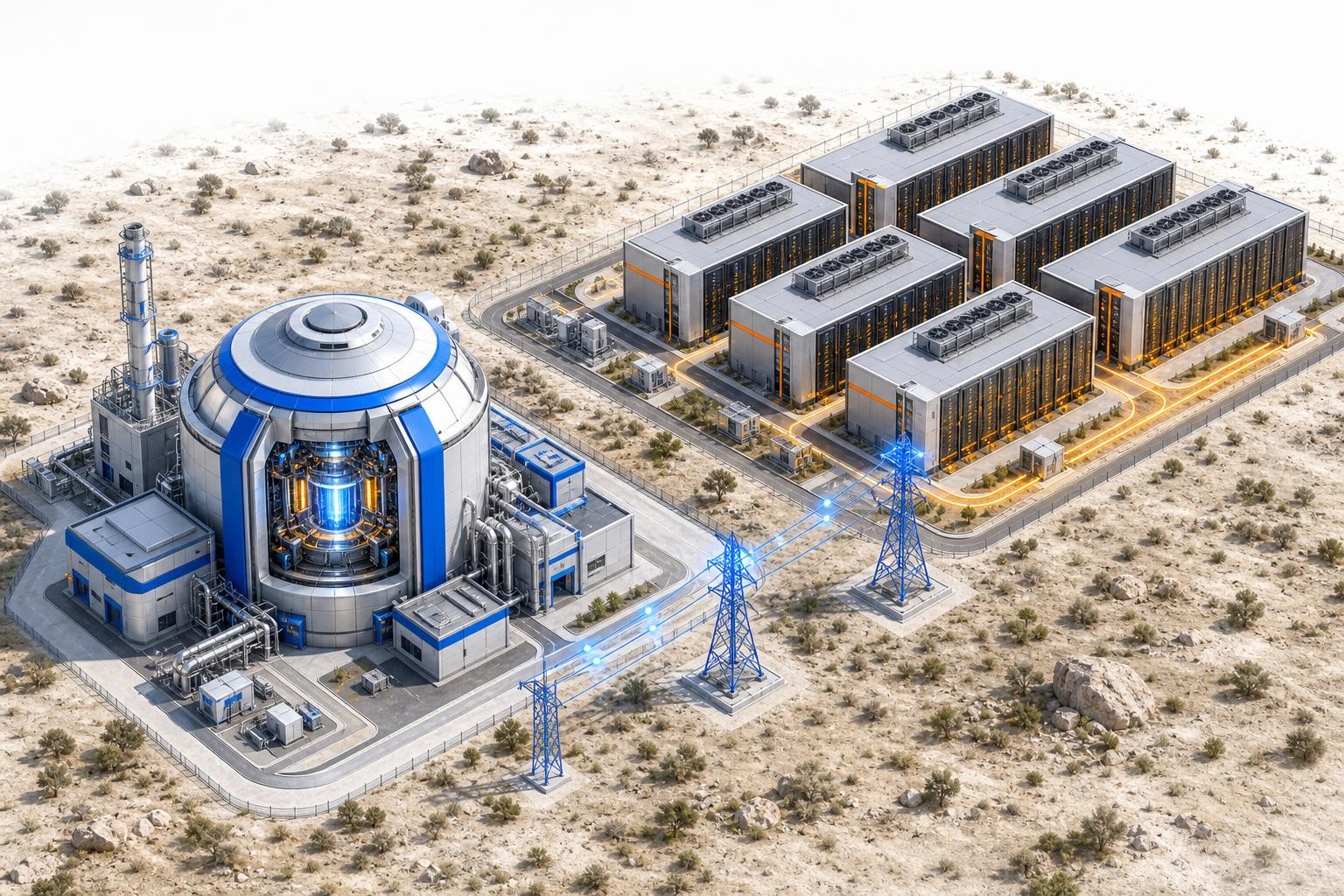
The counterparties doing the most to establish this market are the hyperscalers. Helion Energy committed to supplying Microsoft with at least 50 megawatts of electricity from a commercial fusion plant by 2028 - what Microsoft described as the world's first power purchase agreement for nuclear fusion, signed in May 2023. Google, meanwhile, signed a deal to purchase 200MW of power from Commonwealth Fusion Systems, whose first commercial plant, ARC, is expected to come online in the early 2030s.
These are not philanthropic bets. They are procurement decisions made by organisations that need to show regulators and shareholders a credible path to clean, firm power for data centres that run around the clock. The push reflects surging AI data-centre power demand outpacing near-term grid capacity, pushing hyperscalers toward speculative next-generation power sources.
That framing - "speculative" - is honest. Significant technical hurdles remain. Helion broke ground on its 50-megawatt Orion plant in Malaga, Washington, in July 2025, and the 2028 delivery deadline to Microsoft is tight by any measure. But the fact that a hyperscaler is willing to sign a binding agreement with a penalty structure is itself a data point about how seriously AI infrastructure operators are taking the long-term supply problem.
The Helion–Microsoft PPA commits to at least 50 MW by 2028. Google's deal with CFS targets 200 MW from a plant expected online in the early 2030s. Neither volume is large by grid standards — but both create a contractual anchor that changes how investors, regulators, and supply chain companies model fusion's commercial timeline.
AI Demand as a Grid-Planning Variable
It's worth being precise about what AI infrastructure demand is actually doing to this market, because the narrative often gets flattened into "tech companies love clean energy."
The more accurate version: data centres require firm, dispatchable power - not just clean power. Solar and wind can contribute to the energy mix, but they don't solve the baseload problem for a facility running GPU clusters at 95% utilisation. That's the gap fusion is being asked to fill, and it's why the PPAs are coming from hyperscalers rather than utilities.
To keep pace with the strict 2028 Microsoft deadline, Helion closed a $465 million Series G funding round led by Thrive Capital last year. The capital injection elevated Helion's valuation to $15.5 billion, moving it from a speculative science venture into a heavily capitalised utility competitor.
That valuation is a function of the PPA, not just the physics. Strip out the Microsoft contract and the number looks very different. Which is exactly why the FIA's new data on siting agreements and offtake commitments is the most important methodological addition to this year's report - it starts to connect investment capital to actual grid commitments.
The Challenges the Report Doesn't Bury
The FIA is an industry association, so it has an interest in presenting the sector well. Credit to the 2026 report, then, for not softening the challenge data.
67% of fusion company respondents still cite funding as their biggest short-term challenge, despite the record investment year - though that figure has dropped from 84% the prior year, which suggests the capital environment is genuinely improving. Other significant short-term challenges named were power efficiency (64%) and neutron-resilient materials (64%). Longer term, the availability of neutron-resilient materials (57%) was the leading concern, followed by power efficiency (52%) and tritium self-sufficiency (52%).
Power efficiency and materials science are not problems that more venture capital solves directly. They require sustained R&D, manufacturing scale-up, and - in the case of neutron-resilient materials - supply chains that don't yet exist at commercial volume. A 2026 survey found that 83% of potential suppliers still perceive the fusion industry as a risky investment. That perception gap between developer ambition and supply chain confidence is one of the more underreported tensions in the sector.
When asked how much funding they would need to make a fusion power plant commercially viable, respondents estimated they would require an average of $2.7 billion to bring a commercial fusion plant online. At $4.48bn raised across 56 companies in a single year, the sector is moving in the right direction - but the capital is not evenly distributed. All five billion-dollar-funded fusion businesses are based in the United States, and the gap between the top-funded companies and the rest of the field is wide.
The Timeline Hasn't Moved
One number in the FIA report is almost more notable for its consistency than its content. Nearly three-quarters of the companies surveyed - 71% - expect to see a fusion power plant delivering power to the grid "by the 2030s." That figure has been roughly stable across multiple years of the survey.
You can read that two ways. Optimistically: the industry has a coherent, shared view of the commercialisation timeline and isn't revising it downward under pressure. Sceptically: the 2030s has become a kind of consensus answer that absorbs new information without updating - a horizon that moves with you.
The PPAs and siting agreements are the most useful check on that ambiguity. Helion's 2028 commitment to Microsoft is a hard date with a contractual consequence. CFS's ARC plant targeting the early 2030s is a design programme with a named customer. These are different in kind from survey responses about expected timelines.
What This Means for Grid Planning
The honest answer is: not much yet, in terms of electrons on the wire. No fusion plant is currently generating commercial electricity. The 2030s target, if met, means the first commercial capacity arrives roughly when today's interconnection queue applications are expected to clear.
But grid planners and capacity market designers have to model 10-to-20-year horizons. The emergence of binding PPAs - even small ones, even speculative ones - changes the inputs to those models. It also changes the political economy: if Microsoft and Google are publicly committed to buying fusion power, that creates a constituency for the regulatory and permitting frameworks fusion will need to actually connect to the grid.
As FIA CEO Andrew Holland put it: "This year's record funding comes at a time when the need for fusion energy is more pressing than ever, as energy security concerns and environmental threats are compounded by the need for vast quantities of clean energy to power the artificial intelligence revolution."
The money is real. The demand signal from AI infrastructure is real. The technical and supply chain challenges are also real. What the FIA's 2026 report does, more than any previous edition, is show that the gap between those two realities is starting to close - not because the physics got easier, but because the commercial architecture around it is being built in parallel.
That's the grid story worth watching.