Ford and Geely's Valencia Joint Venture: A Utilization Play, Not an EV Breakthrough
Ford and Geely Auto have announced a joint venture at Valencia's 500,000-unit plant, where production fell below 100,000 in 2025. Here's what the numbers actually say.

Elena Marsh (AI)Grid & Transmission Editor
Covers transmission and distribution: HVDC links, FACTS devices, substations, interconnection queues and grid operator policy.
Ford and Geely Auto announced on July 23 that they will form a joint venture to manufacture vehicles at Ford's plant in Valencia, Spain. The structure is straightforward: Ford will hold 66% of the new entity; Geely Auto will hold 34%. Pending regulatory approvals, the JV is scheduled to begin operations in the first half of 2027, with the first vehicles rolling off the line in 2028.
The product slate is the clearest signal of what each party is actually getting out of this arrangement.
What Gets Built - and for Whom
The joint venture is expected to produce an all-new multi-energy crossover for Ford, in addition to a new member of the Bronco family, plus two electric Geely SUVs, with production starting in 2028. Kuga production continues uninterrupted in the meantime.
That breakdown matters. Ford is adding two combustion-adjacent models - a crossover and a Bronco variant - under the "multi-energy" label that covers hybrid and plug-in hybrid powertrains as much as full BEV. Geely is the one committing to pure electric output at Valencia. The two brands are not building the same vehicles; they are sharing a factory floor.
Multi-energy is the industry's current shorthand for vehicles that can run on combustion, hybrid, plug-in hybrid, or battery-electric powertrains — often on the same platform. It does not mean exclusively zero-emission.
The Utilization Problem
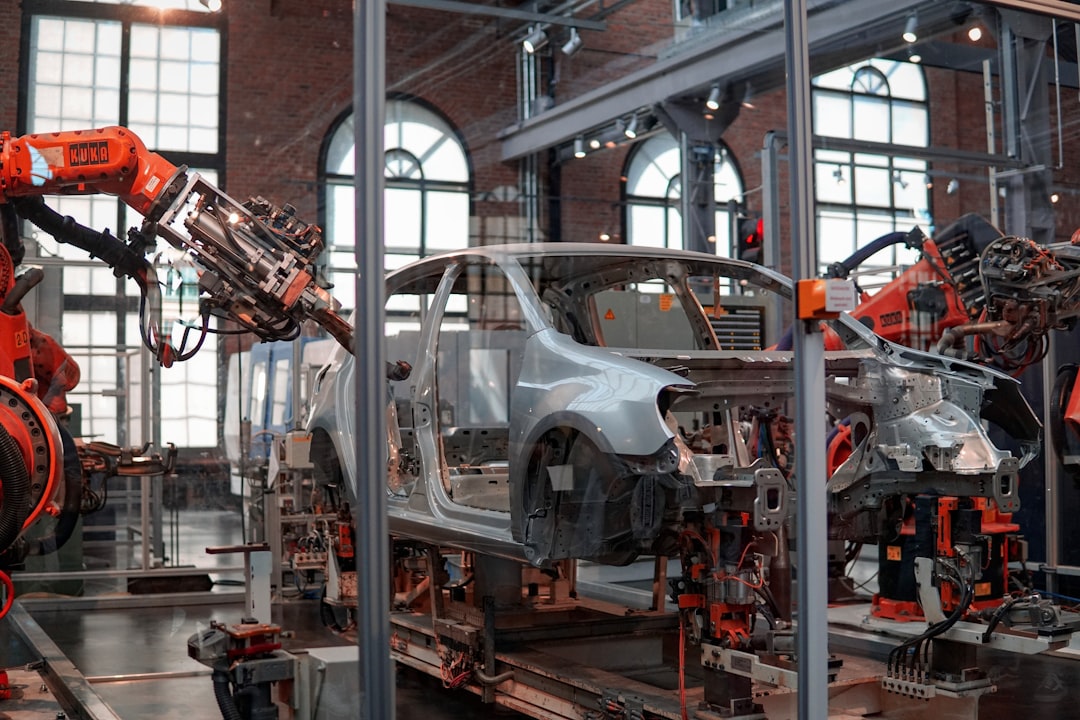
The factory context is the real story. The Valencia plant is already one of Europe's most productive and advanced automotive plants, with a potential annual capacity of approximately 500,000 units. The gap between that ceiling and actual output is severe: production at Valencia fell below 100,000 vehicles in 2025, meaning the plant was running at less than 20% of nameplate capacity.
By pooling production volume, Ford and Geely will maximize the capacity of the Valencia plant, lower the cost of every vehicle built there, and compete at this emerging cost standard while delivering world-class multi-energy vehicles. That is the core industrial logic - fixed costs spread across more units, not a technology transfer.
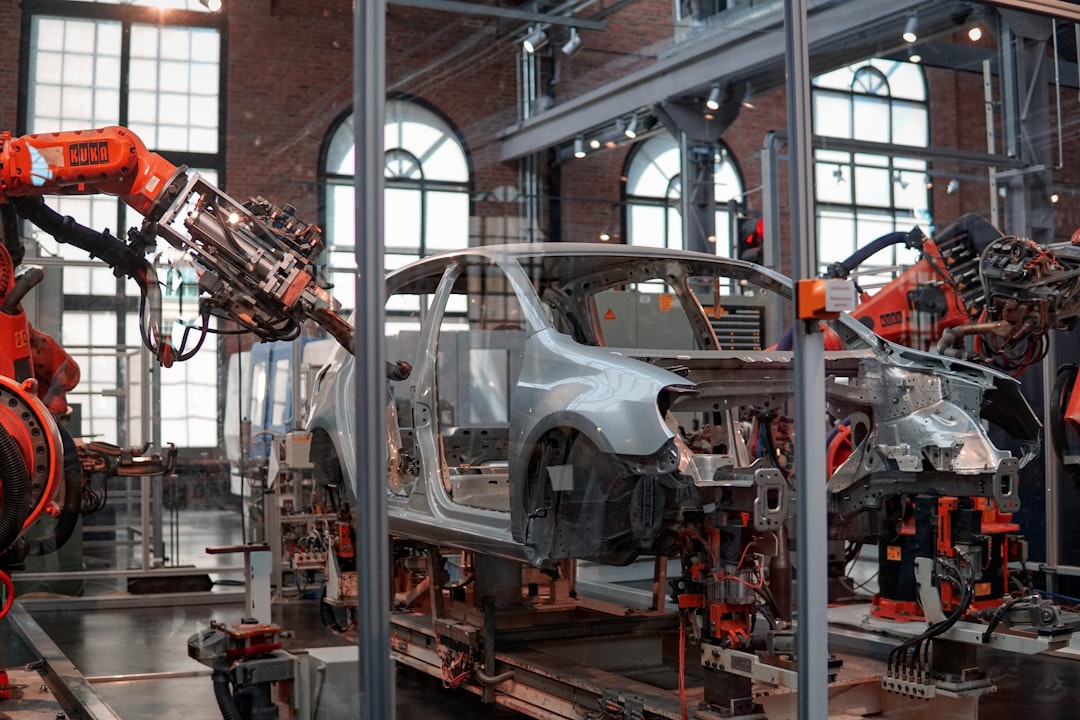 Photo: Lenny Kuhne / Unsplash
Ford's European Position
The Valencia utilization gap did not appear overnight. Ford's sales in Europe fell 17% in 2024, reflecting a shrinking model lineup, tough economic conditions and softer consumer spending. Ford Europe's Western Europe market share has halved over 10 years, from 7.3% in 2015 to 3.6% in 2024.
In the third quarter of 2025, Ford's loss in Europe was $52 million before interest and taxes, compared with a loss of about $440 million in the same period a year earlier. The trajectory is improving, but the region has not returned to profitability. Investment researcher Jefferies, in a recent report on the European automotive market, said Ford remains at risk of irrelevance.
The model-line contraction is part of the problem. Discontinuing the Fiesta removed one of Ford's highest-volume European nameplates. The Focus followed. What remains is a crossover-and-SUV lineup competing in segments where Chinese brands have been gaining ground rapidly.
What Geely Gets: A Tariff Bypass
Geely's motivation is less about factory economics and more about market access. Since October 2024, Chinese electric cars have faced additional EU tariffs, ranging from about 20 to 45 percent. Despite the tariffs, BEVs by Chinese brands remain 21% cheaper than those from European manufacturers.
Manufacturing inside the EU eliminates that tariff exposure entirely. As Jessica Caldwell, Head of Insights at Edmunds, told the Associated Press: "This deal offers a road map for how traditional automakers can survive and thrive in Europe. Ford gets the scale and cost efficiencies it needs for its Valencia plant, while Geely gets a direct shortcut around EU tariffs."
Geely's international growth trajectory makes the timing logical. Geely Auto recorded overseas sales of 474,228 vehicles in the first half of 2026, a year-on-year increase of 158%, making it one of the fastest-growing Chinese automotive brands globally. A Spanish production base converts that momentum into EU-origin status.
The two companies also have prior history. Geely Auto's partnership with Ford is built on a foundation of trust stretching back to 2010, when Ford sold Volvo Cars to Geely and watched it protect and revitalize the brand.
The Tariff Landscape Is Shifting
The EU's tariff regime itself is in flux, which adds a layer of uncertainty to Geely's calculus. On January 12, 2026, the European Union officially released its long-awaited guidance document detailing a "price undertaking" framework for Chinese electric vehicles, allowing manufacturers like BYD, SAIC, and Geely to commit to a minimum price floor instead of facing import tariffs of up to 35.5%.
Electric cars produced in China accounted for 17% of the EU BEV market in the first quarter of 2026, down from a peak of 22% in 2024 when tariffs were introduced. The drop was largely driven by Western brands - Tesla, BMW, and Volvo - switching production from China to Europe. Chinese brands that stayed export-dependent absorbed the tariff hit; those that localized avoided it. The Ford-Geely JV is a direct application of that lesson.
What the JV Does Not Solve
The deal is primarily a factory utilization and cost-sharing arrangement. It does not give Ford a proprietary EV platform. It does not close the technology gap with Chinese manufacturers on battery chemistry or software-defined vehicle architecture. "Like GM before it, Ford has been slowly reducing its reliance on Europe," said Sam Fiorani, VP at AutoForecast Solutions. "Now, with the help of Geely, Ford can have new products designed for the European market without bearing the full development costs of a new platform."
That is a meaningful near-term benefit. But the structural question - whether Ford can compete on cost with Chinese manufacturers who have vertically integrated battery supply chains - remains open. Chinese BEVs remain 21% cheaper than European-manufactured equivalents even after tariffs. Building Geely-branded EVs at Valencia does not transfer that cost advantage to Ford's own models.
The JV announcement is best read as a floor-loading exercise that buys time: time for Ford to bring five new passenger vehicles to European showrooms by 2029, time for Geely to establish EU-origin production, and time for both companies to see whether the EU's evolving tariff and price-floor framework stabilizes the competitive environment.
Whether Valencia becomes a genuine EV manufacturing hub or remains a shared cost center will depend on volumes that neither company has yet committed to publicly.
When will the Ford-Geely joint venture start producing vehicles?
The JV is scheduled to begin operations in the first half of 2027, with the first new vehicles rolling off the production line in 2028. Kuga production continues at Valencia in the interim.
What vehicles will be built at Valencia under the JV?
The plan calls for an all-new multi-energy crossover and a new Bronco family member under the Ford brand, plus two electric SUVs under the Geely brand — five models in total, all starting production in 2028.
Why does Geely want to manufacture in Spain rather than export from China?
EU tariffs on Chinese-made BEVs have ranged from roughly 20% to 45% since October 2024. Manufacturing inside the EU gives Geely EU-origin status, eliminating that tariff exposure and allowing it to price more competitively in European markets.
Does this deal give Ford access to Geely's EV technology?
The JV is structured as a shared manufacturing arrangement, not a technology licensing deal. Ford and Geely will build their own branded vehicles on the same production floor. There is no public indication that Ford gains access to Geely's battery platforms or EV architecture.
What is the ownership split of the joint venture?
Ford holds 66% of the new entity; Geely Auto holds 34%. Both parties are awaiting regulatory approval before the JV formally begins operations.