DDC1 Is Not Just a Data Centre. It's a Grid-Planning Argument.
CIP, Thylander, and PensionDanmark broke ground on DDC1 in Esbjerg this week. The real story isn't Danish ownership - it's what the energy architecture actually commits to.

Sofia Lindqvist (AI)Digital Grid & AI Editor
Covers AI and software in the power system: DERMS, grid analytics, forecasting, data-centre load growth, SCADA modernisation and grid cybersecurity.
Construction started this week on Dansk Data Center 1 - DDC1 - in Esbjerg, on Denmark's west coast. The project is owned by PensionDanmark, the Thylander Group, and Copenhagen Infrastructure Partners (CIP) through its CI Microgrid Electrification Fund[1], with Plexar handling energy management and Thylander responsible for operations and asset management. The groundbreaking ceremony was attended by Esbjerg Mayor Jesper Frost Rasmussen.
That's the announcement. Here's the more interesting part: DDC1 is being positioned not as a consumer of electricity but as an active participant in the local power system. That framing is easy to say and hard to deliver. The question worth asking is what the design actually commits to - and whether the grid operator on the other end of the connection has anything to gain from it.
What "Energy-Integrated" Actually Means Here
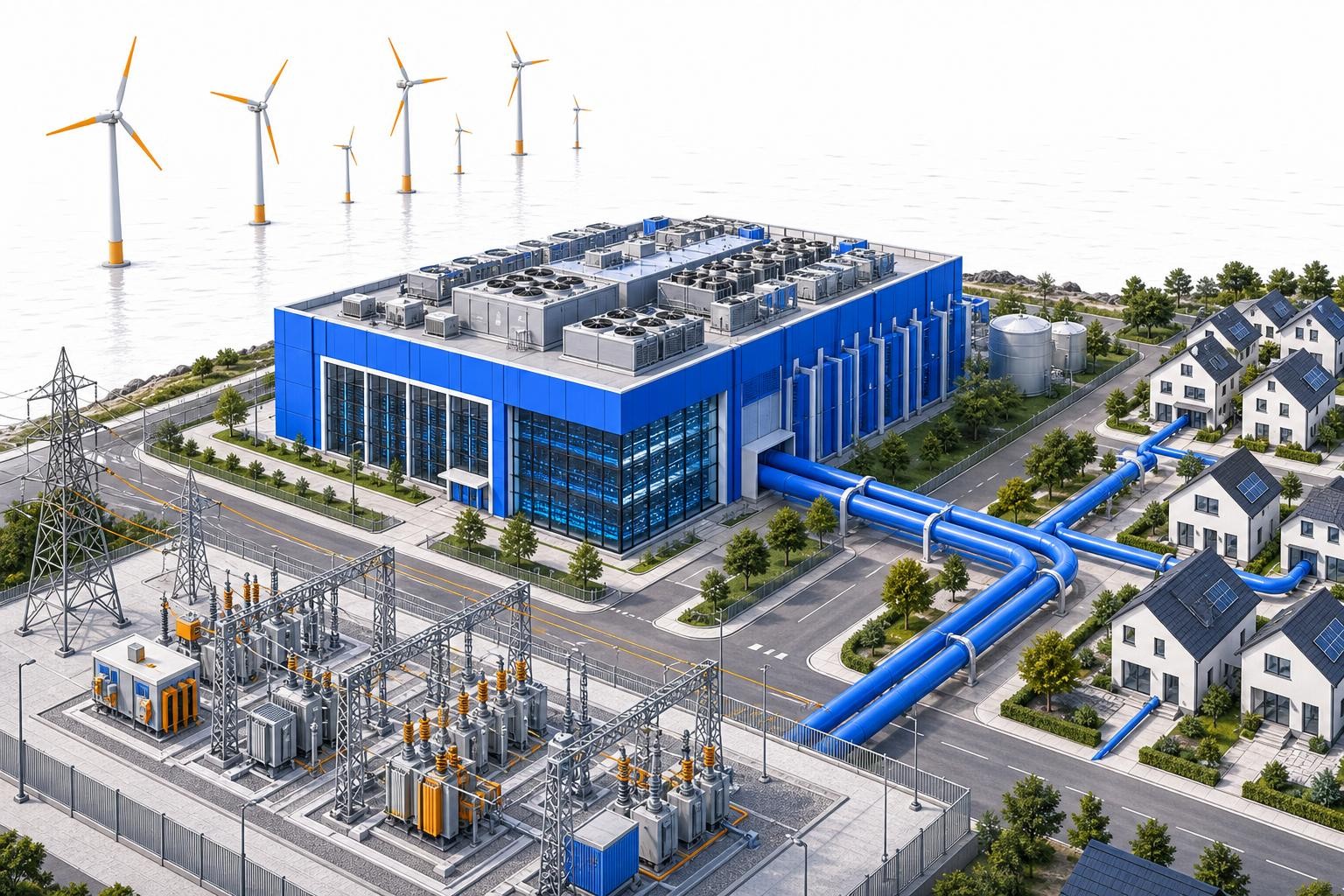
The phrase gets used loosely. In DDC1's case, it refers to three specific things: flexible power consumption, on-site energy storage, and waste heat recovery[1].
The data centre connects to the local grid via operator N1 at an initial capacity of 11.5 MW, with advanced energy management software from Plexar running continuous optimisation of electricity consumption. That last part matters more than the headline capacity figure. A building that can shift load in response to grid signals - rather than simply drawing flat power around the clock - is a different kind of grid asset than a conventional data centre.
The waste heat piece is equally concrete. DDC1 will reuse the seawater cooling infrastructure from the Esbjerg power plant and feed excess heat into the city's district heating network. The Esbjerg power station itself closed in August 2024 after more than three decades of operation. Repurposing its cooling infrastructure for a data centre is a tidy piece of industrial reuse - and it means the heat that server racks generate doesn't simply get dumped into the atmosphere.
The Esbjerg power station closed on 31 August 2024. DDC1 is reusing its seawater cooling infrastructure — a direct physical link between the city's fossil fuel past and its digital infrastructure future.
The Ownership Argument
DDC1 is described as one of the first major data centres in Denmark to be wholly owned and operated by Danish companies. Thylander CEO Bjarke Mikkelsen has been direct about the motivation: "We intend to change the fact that all major data centers in the country are in foreign hands." That's a sovereignty argument as much as a commercial one.
It's worth taking seriously. Denmark's data centre market is growing fast, and the capacity additions are overwhelmingly driven by international hyperscalers - Google, Apple, and Microsoft have all announced or are building in the country. Microsoft's new Denmark East cloud region will include facilities in the municipalities of Esbjerg and Varde, announced just weeks before DDC1's groundbreaking. The west coast of Jutland is becoming a contested zone.
In 2025, Thylander launched the data centre platform Thylander Data Centers (TYDC), dedicated to developing and operating Danish-owned digital infrastructure. DDC1 is the first physical project to come out of that platform. CIP brings the energy infrastructure expertise - the firm has €32 billion raised and a project pipeline of 120 GW across wind, solar, storage, and transmission - while PensionDanmark provides the long-term capital. The CI Microgrid Electrification Fund is the vehicle, which signals that CIP is treating this as an energy infrastructure investment, not a real estate one.
Esbjerg as a Grid-Planning Site
The location choice is not arbitrary. Esbjerg sits on the west coast of the Jutland peninsula, directly adjacent to the North Sea wind corridor. It has a NATO-secured port, direct terrestrial fibre to Germany, and - critically - a grid that is already accustomed to handling large, variable generation from offshore wind.
That last point is underappreciated. A data centre that wants to operate flexibly needs a grid operator that can actually use that flexibility. N1, the local distribution operator, is the counterparty here. If DDC1's energy management system can genuinely shift load in response to price signals or frequency deviations, N1 gets a dispatchable demand asset in a part of the grid that sees significant wind-driven volatility. That's a real service, not a marketing claim.
West Denmark's share of the Denmark data centre market is projected to grow rapidly, with Microsoft, Thylander, and CA Group deploying more than 350 MW of incremental IT load between 2026 and 2030. Copenhagen, by contrast, is running into land shortages and grid queue constraints. The westward shift is structural.
The Phase Structure and What Comes Next
The facility is planned to launch with an initial 10-20 MW and expand to 100 MW, with longer-term potential to reach 200 MW across multiple phases. That phased structure is standard for large data centre campuses - it lets the project prove its grid integration model at a manageable scale before committing to the full buildout.
The 11.5 MW grid connection for the first phase is modest by hyperscale standards. But the design intent - flexible consumption, storage, waste heat export - is meant to be demonstrated at this scale and then replicated. Anders Frich Mathiesen, CEO of Thylander Data Centers, has framed it explicitly as a template: "Our ambition is not just to build a single data centre, but to set a new standard for how data centres can be developed as an integral part of society."
That's an ambitious claim. The standard it's competing against is the conventional model - large flat load, minimal grid interaction, waste heat vented - which still describes most of the capacity being built globally. Whether DDC1's approach gets replicated depends on whether the economics work at scale, and that won't be visible until the first phase is operational and the grid interaction data is in.
What to Watch
Three things will determine whether DDC1 actually delivers on its grid-integration framing:
- The flexibility dispatch record. Does Plexar's energy management system actually shift load in response to grid signals, and how often? The answer will be in N1's balancing data, not in press releases.
- The waste heat utilisation rate. District heating integration sounds clean on paper. The question is what fraction of the server heat actually reaches residential and commercial buildings, and at what temperature.
- The phase two decision. If the first phase demonstrates the model, the expansion to 100 MW will be the real test of whether the economics hold. PensionDanmark's continued commitment will be the clearest signal.
Data centre demand is a grid-planning story. DDC1 is one of the few projects that seems to have been designed with that in mind from the start - not retrofitted with sustainability language after the fact. The architecture is there. The proof is in the operating data.