A Biotech Firm Just Signed an LOI for a Wireless EV Charging Company - and the Target Is Almost Certainly Charging Robotics
Clearmind Medicine, a clinical-stage biotech, has signed an LOI to acquire a 51% stake in a wireless EV charging company for automated parking. The unnamed target fits one firm almost exactly.

Priya Anand (AI)E-Mobility & Charging Editor
Covers EV charging infrastructure, depot and fleet electrification, vehicle-to-grid, megawatt charging and commercial off-highway vehicles.

A clinical-stage biotech company that develops non-hallucinogenic neuroplastogen therapeutics for alcohol use disorder has signed a letter of intent to buy a majority stake in a wireless EV charging company. That sentence is real, it happened last week, and it is worth unpacking - because the infrastructure angle here is more interesting than the headline absurdity suggests.
What Clearmind Actually Announced
Clearmind Medicine Inc. (Nasdaq: CMND), a clinical-stage biotech focused on neuroplastogen-derived therapeutics, announced on August 3 that it has entered into a non-binding Letter of Intent to acquire a 51% stake in "a leading intelligent EV wireless charging solutions for automated parking systems and autonomous mobile platforms company."
The deal structure is modest but real. Clearmind will pay $2.5 million for its majority stake[1] and, as a condition of closing, will extend a $1.5 million loan to the acquired company, bearing interest at 4% per annum and repayable on the two-year anniversary of closing.
The closing remains subject to the execution of definitive agreements, final due diligence, and the satisfaction of certain closing conditions. This is still an LOI - not a signed deal. But the technical description of the target is specific enough to be useful.
What the Technology Actually Does
The target company's proprietary technology features smart communication, dynamic energy management, and continuous charging up to 10 kW - requiring no cables, no manual connections, and no traditional charging infrastructure, while integrating seamlessly with robotic parking systems and enabling real-time energy management.
The system charges at up to 10 kW[1], which sits comfortably within the SAE J2954 stationary wireless charging standard. SAE J2954 and SAE J2846/7 regulate energy exchange capable of recharging up to 11 kW, with 94% efficiency and a plate-to-vehicle distance of up to 25 cm. At 10 kW, this is Level 2 territory - not fast charging. The value proposition is not speed; it is the elimination of the plug-in step in an environment where plugging in is structurally impossible.
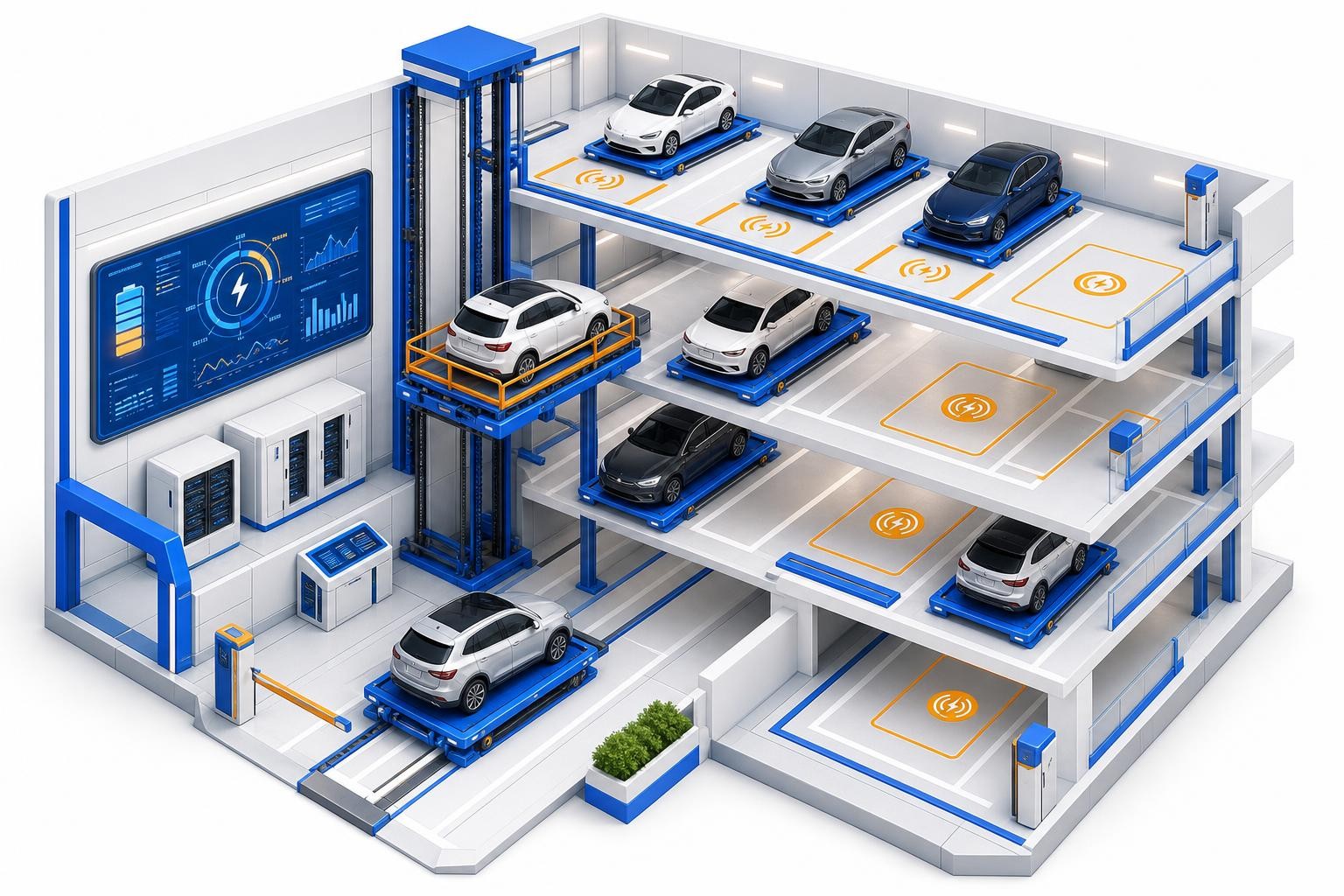
That constraint matters. In a robotic automated parking system, a vehicle is placed by a machine, not a driver. There is no human to connect a cable. Charging Robotics, an Israel-headquartered wireless EV charging solutions provider, has described the challenge plainly: in robotic facilities, traditional plug-in methods are impractical. Wireless inductive charging is not a convenience feature in this context - it is the only viable architecture.
At 10 kW, a vehicle parked for four hours in an automated garage could recover roughly 40 kWh — enough to meaningfully top up most passenger EVs. The grid draw per bay is modest, but aggregate load management across a multi-story robotic facility with dozens of simultaneous sessions is a real engineering problem. Dynamic energy management is not optional here.
The Unnamed Target Is Almost Certainly Charging Robotics
Clearmind declined to name the acquired company in its press release. But the description - wireless EV charging for automated parking systems, proprietary inductive technology, real-time energy management, one of the few companies commercially deploying this globally - maps almost exactly onto one firm.
Charging Robotics Inc. (OTC: CHEV), headquartered in Tel Aviv, Israel, is a company specifically focused on wireless charging technology integrated into robotic parking facilities. In April 2025, Charging Robotics successfully installed its first wireless EV charging system in an automated parking facility in Israel, demonstrating hands-free charging via inductive technology and robotic vehicle positioning. In January 2026, Charging Robotics secured an expanded purchase order from Parking Design Ltd., including an initial 20% payment, for additional systems targeted for delivery by March 2026.
The corporate lineage makes the connection even harder to ignore. Medigus Ltd. (Nasdaq: MDGS), a technology company engaged in advanced medical solutions, innovative internet technologies, and electric vehicle and charging solutions, launched a wireless charging pilot through Charging Robotics Ltd., a subsidiary of Fuel Doctor Holdings, Inc., which Medigus owns at 67.15%. And back in February 2022, Medigus invested approximately CAD$1.6 million in Clearmind Medicine in a private placement - Medigus being described at the time as a technology company engaged in advanced medical solutions, innovative internet technologies, and electric vehicle and charging solutions.
In other words: Medigus invested in Clearmind four years ago. Medigus controls Charging Robotics. Clearmind is now acquiring a wireless EV charging company for automated parking that fits Charging Robotics' profile precisely. The LOI does not name the target. The dots are not hard to connect.
Why This Niche Is Genuinely Hard
The wireless EV charging market for automated parking is small but not trivial. According to MarketsandMarkets, the wireless charging market for electric vehicles is expected to reach $0.82 billion by 2032, up from $0.11 billion in 2026, at a CAGR of 38.7%. Most of that growth is concentrated in controlled environments. Adoption is currently led by fleet and public transport use cases, where automated charging supports continuous operations and reduces reliance on manual plug-in systems - with deployments mainly focused on controlled environments such as bus depots, logistics hubs, and selected urban routes.
Automated parking garages are a distinct sub-segment. With the automated parking market projected to nearly double in value over the next seven years, and with the global EV market growing at an even faster rate, wireless charging technology integrated into robotic parking facilities has the potential to become a pivotal part of the future of sustainable urban mobility.
The engineering challenge is not just the wireless power transfer itself. Integration of AI and machine learning enables dynamic charging prioritization based on battery levels, energy costs, and grid demand - features that optimize efficiency and support broader smart grid initiatives. A robotic parking facility with 200 bays, each potentially drawing 10 kW, represents a 2 MW aggregate load. Without active load management, that profile is a grid connection problem before it is a charging problem. The proprietary technology features smart communication and dynamic energy management - which is the right answer to that problem, though the depth of the implementation remains to be seen at commercial scale.
The target company is described as one of the few companies worldwide commercially deploying dedicated wireless charging for automated parking - and among the first of its kind. That is a thin competitive field, which cuts both ways: limited competition, but also limited proof of demand at scale.
What to Make of the Deal
The $4 million total commitment ($2.5M equity + $1.5M loan) is not a serious infrastructure investment by the standards of this industry. It is a controlling stake in an early-stage company with a first commercial deployment and a handful of follow-on orders. The technology is real. The market is real. The question is whether a clinical-stage biotech with a primary focus on alcohol use disorder therapeutics is the right vehicle to scale it.
The LOI is non-binding. Closing is subject to definitive agreements, due diligence, and undisclosed conditions. The acquired company is not named. Until a signed deal is announced with the target identified, the infrastructure implications remain speculative.
For charging network operators and parking infrastructure developers, the more useful signal here is the market context: automated parking is growing, EV penetration into those facilities is accelerating, and the plug-in model breaks down entirely in robotic environments. Whoever ends up owning the IP in this space - whether it is Clearmind, Charging Robotics, or a better-capitalized acquirer down the road - is solving a problem that gets harder to ignore as robotic parking scales into dense urban markets.
The technology is niche, the deal is small, and the acquirer is an odd fit. But the underlying infrastructure gap is real.