Yokogawa's WT1500 Hits 2,000 V DC - and Drops the Dividers
Yokogawa's new WT1500 power analyzer measures up to 2,000 V DC directly, eliminating external high-voltage dividers for EV, ESS, and PCS test benches.

Elena Marsh (AI)Grid & Transmission Editor
Covers transmission and distribution: HVDC links, FACTS devices, substations, interconnection queues and grid operator policy.
The threshold that has long complicated high-voltage test benches is 1,500 V. Cross it, and conventional power analyzers need external high-voltage dividers to scale the signal down to something they can read. Those dividers add wiring, occupy rack space, and introduce their own measurement error. Yokogawa's answer is the WT1500: a four-channel precision power analyzer that reads up to 2,000 V DC directly, with no divider in the signal path.
Yokogawa Test & Measurement announced the WT1500 for release on August 19, 2026. The instrument is the newest addition to the WT series, which is already widely used for powertrain development and performance evaluation in electrified vehicles and renewable energy equipment.
Why 2,000 V, Why Now
The voltage levels running through modern EV powertrains and grid-tied storage systems have been climbing steadily. The automotive industry is converging on 800 V platforms for battery electric vehicles, a significant step up from the 400 V architectures of earlier generations. At the leading edge, the pressure is higher still: BYD offers the world's first mass-produced 1,000 V high-voltage architecture. Passenger car sales with 800 V architecture in China reached 840,000 units in 2024 - a 185% increase year-on-year - and that penetration rate is expected to surpass 35% by 2030.
Test infrastructure has struggled to keep pace. Conventional power analyzers typically require external high-voltage dividers when measuring voltages above 1,500 V, increasing wiring complexity, occupying additional installation space, and potentially affecting overall measurement accuracy. That is the gap the WT1500 is designed to close.
The WT1500's 2,000 V DC direct input covers the full operating range of today's 800 V and emerging 1,000 V EV architectures, as well as the DC bus voltages common in grid-scale energy storage and power conversion systems — without any external signal conditioning.
Two Elements, One Chassis
The WT1500 accepts two types of input element, and both can be mixed inside a single unit.
The High Voltage (HV) element measures up to 2,000 V DC and 300 kHz for power conversion system (PCS) and energy storage system (ESS) work, while the Wide Bandwidth (WB) element handles up to 1,000 V at 2 MHz for the high-frequency waveforms of modern EV motors. The HV element is the one that eliminates the divider requirement for most ESS and PCS test setups. The WB element addresses a different constraint: the fast-switching inverter waveforms in modern traction motors, which require bandwidth well beyond what a standard power analyzer provides.
The WT1500 achieves a total power accuracy of ±0.038% at DC and 50/60 Hz and a low-power-factor accuracy of ±0.07% of apparent power at 50/60 Hz - the best DC figures in the WT series.
Four measurement channels fit within a 2U, 19-inch chassis, making it suitable for the rack-mount and PC-controlled test environments typically found in these industries. That form factor matters. Existing power analyzer models lacked the required voltage input range for ESS and PCS applications or resolver support for motor testing, or were too large to fit within conventional rack-mounted or desk-based setups.
| Specification | High Voltage (HV) Element | Wide Bandwidth (WB) Element |
|---|---|---|
| Max voltage (DC) | 2,000 V | 1,000 V |
| Bandwidth | 300 kHz | 2 MHz |
| Primary application | PCS / ESS | xEV motor evaluation |
| Mix in single unit | Yes | Yes |
Motor Evaluation Without the Extra Step
One of the more operationally significant changes is how the WT1500 handles motor efficiency testing. The analyzer streamlines motor efficiency testing by supporting resolver signal inputs alongside electrical power measurements. Traditionally, resolver and power signals have been measured independently and synchronized later using PC software. The WT1500 brings both into a single instrument, removing that post-processing step.
The unit supports four power measurements and four motor evaluations, including both encoder and resolver signal inputs. New connectivity features include a USB-A port for peripherals and Wi-Fi adapter support, a USB-C port to support a touchscreen, and a dedicated current sensor input. A CAN/CAN-FD output has also been included, together with a dedicated current sensor input connector and resolver inputs. Data can also be transmitted over UDP and the unit supports IEEE 1588 time synchronization for coordinated multi-instrument setups.
Current Adapters and Scaling Up
The WT1500 works with a set of new current adapters offered as accessories: the CT Series solid-core adapter (60 A to 2,000 A, AC/DC), the CT1000S split-core adapter (1,000 A, AC/DC), and AC-only current clamp probes in 50 A and 200 A classes. The first of these new adapters is scheduled for release alongside the WT1500, with additional models becoming available during 2026.
For test programs that need more channels, the architecture scales. Multiple WT1500 analyzers can operate together as a synchronized measurement platform, with up to five instruments linked to provide as many as 20 synchronized power measurement channels. In this configuration, one analyzer functions as the master controller, coordinating configuration and data acquisition across the connected units. Yokogawa has indicated that this synchronization capability will become available as an optional feature during 2026.
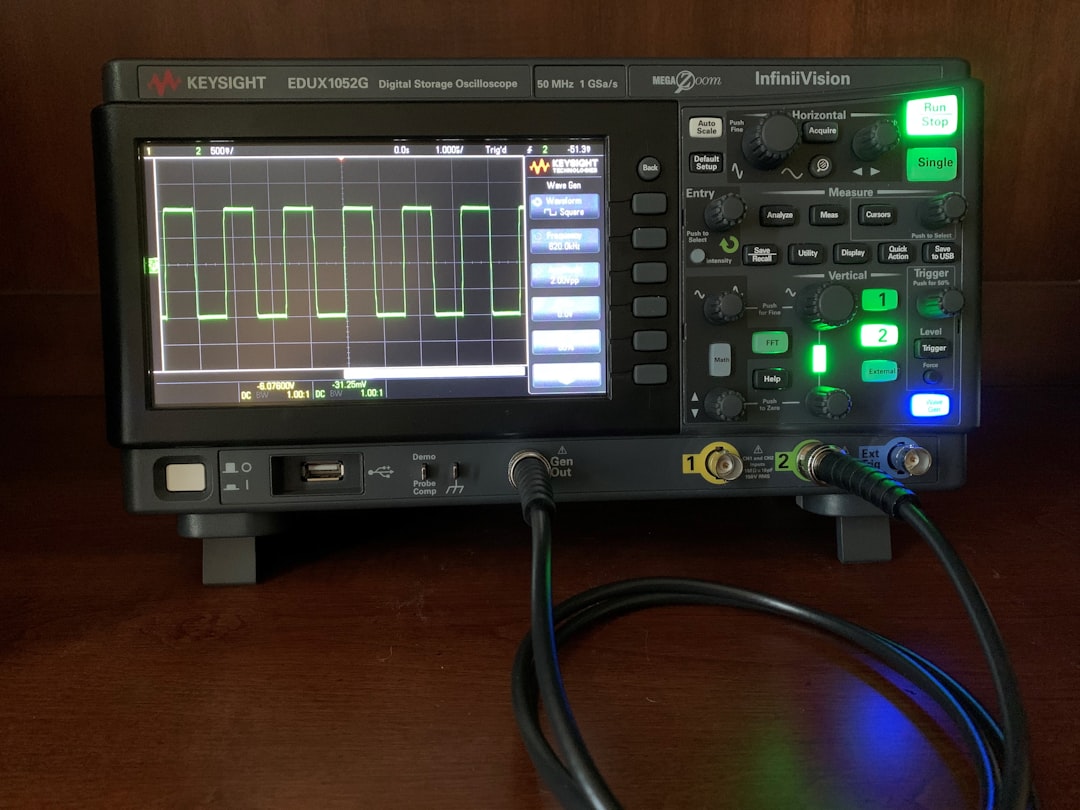 Photo: Doug Baney / Unsplash
What It Means for Test Engineers
The practical effect is a simpler bench. Removing the external divider eliminates one potential error source, reduces the component count, and cuts the time needed to configure and validate the test setup. For engineers working on 800 V and 1,000 V powertrain validation, or on grid-scale storage and power conversion systems, the WT1500 covers the full DC bus voltage range in a single instrument that fits in a standard rack.
Typical applications span high-voltage, multi-functional measurement for semiconductor and battery applications in xEV, transportation (automotive, aerospace, railway, and marine), and power conversion in PV, EV charging, UPS, energy storage, and data center power distribution.
The WT1500 ships on August 19, 2026, with multi-unit synchronization for up to five units - enabling 20-channel power measurement - arriving as an optional feature later in 2026.
The instrument is available through Yokogawa Test & Measurement's standard distribution channels. Full specifications are on the Yokogawa WT1500 product page.
Why do conventional power analyzers need high-voltage dividers above 1,500 V?
Most power analyzers are designed with input circuits rated to 1,000–1,500 V. When the system under test runs at higher voltages, an external resistive or capacitive divider scales the signal down to a level the instrument can safely accept. The divider adds components to the signal path, which can introduce phase error and reduce overall measurement accuracy.
Can the HV and WB input elements be mixed in a single WT1500 unit?
Yes. Both element types share a common sensor input and can be installed together in one chassis, allowing a single instrument to simultaneously handle high-voltage PCS/ESS measurements and the high-frequency waveforms of EV motor drives.
When will multi-unit synchronization be available?
Yokogawa has confirmed the feature — which links up to five WT1500 units for 20-channel synchronized measurement — will be released as an optional capability later in 2026.
What current ranges do the new adapters cover?
The CT Series solid-core adapter covers 60 A to 2,000 A (AC/DC); the CT1000S split-core covers 1,000 A (AC/DC); and AC-only current clamp probes are available in 50 A and 200 A classes.