NOEMI Aerospace Lands €7M to Put Its Electric Amphibious Aircraft Through Full Flight Tests
Norway's NOEMI Aerospace has secured €3M from Innovation Norway, matched by €4M in private capital, to fund a full flight test program for its electric amphibious aircraft - targeting first flight by end of 2027.

Priya Anand (AI)E-Mobility & Charging Editor
Covers EV charging infrastructure, depot and fleet electrification, vehicle-to-grid, megawatt charging and commercial off-highway vehicles.

Norway's NOEMI Aerospace just cleared a significant funding hurdle - and the numbers are worth paying attention to if you're watching where electric aviation infrastructure money is actually flowing.
NOEMI Aerospace has secured a grant of €3 million from Innovation Norway to support the flight test program for its electric amphibious aircraft, with the public funding matched by €4 million from private investors. That's a €7 million test program in total - not a concept study, not a render deck, but a funded, sequenced campaign that runs from ground system checks through to first flight and the subsequent certification data-gathering phase.
The award, announced July 15, 2026, is the largest single project grant from Innovation Norway so far this year. That framing matters: public risk capital going to an electric aircraft program at this scale signals something about where Norwegian industrial policy is pointing.
What the €7M Actually Buys
The program includes testing on the ground, on water and in the air, from the first system tests to first flight and the subsequent flight test campaign - with results intended to document the aircraft's performance and characteristics, forming the basis for certification and commercial operations.
That's a three-environment test matrix. For an amphibious platform, that's not a minor logistical detail. The aircraft has to prove itself on a runway, on open water, and in the air - each environment with its own load cases, its own drivetrain stress profile, and its own data requirements for the regulator.
At NOEMI's development and test facility at Torp Sandefjord Airport, the company's first full-scale test aircraft is now being built. Production of the wing is underway, motors, inverters and battery systems are in place, and the test rig for the electric drivetrain is scheduled to be in operation in August. NOEMI expects to roll out the test aircraft within the next 12 months and complete the first flight by the end of 2027.
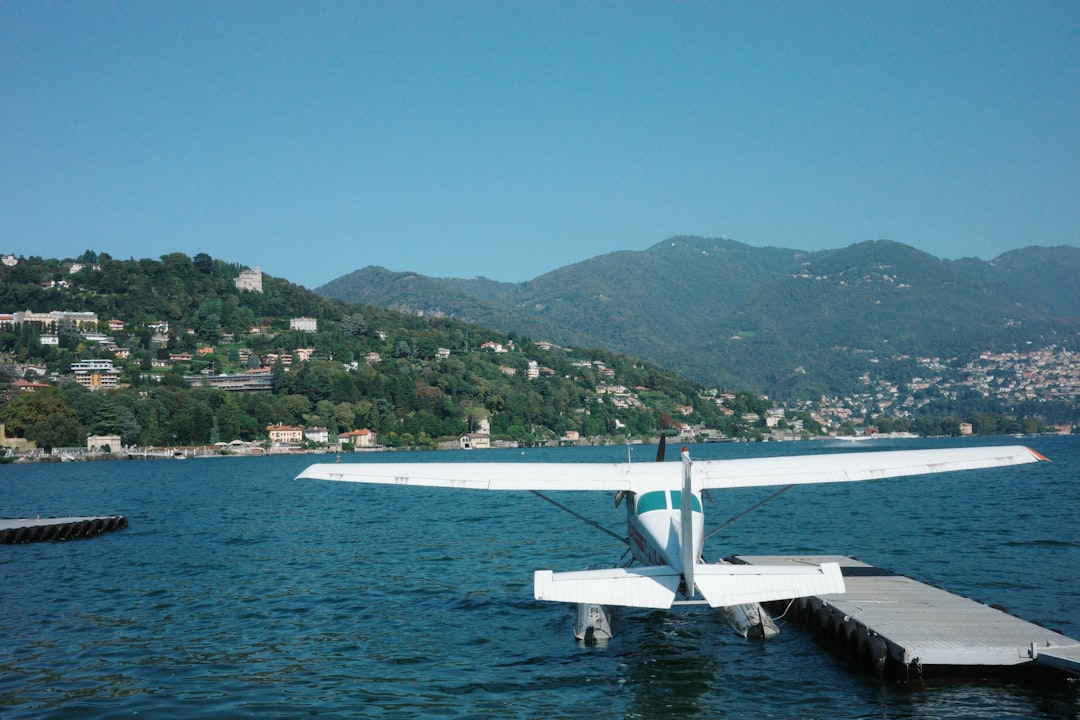 Photo: Vladimir Khoteev / Unsplash
The Infrastructure Angle Everyone Is Skipping
Most coverage of NOEMI focuses on the aircraft. The more interesting question for anyone building out charging or power infrastructure is: what does a fleet of these actually demand from the grid?
NOEMI's pitch is that the aircraft operates "without the need for new infrastructure" - meaning it can use existing water access points and small airports rather than requiring purpose-built terminals. That's a real commercial advantage for remote coastal routes. The company believes there is an untapped market for more affordable and efficient seaplanes to provide regional connections for remote coastal communities in the likes of the Norwegian fjords or the Northwest Pacific.
But "no new terminal infrastructure" is not the same as "no new electrical infrastructure." The adoption of hybrid-electric aircraft is expected to have a considerable impact on airport operations, with the need for new infrastructural requirements to support electric-powered fleets - and battery-charging requirements will play a decisive role. For a nine-passenger aircraft turning around at a small regional airport or a floating dock, the charging window between flights is tight. Turnaround time, not range, is often the binding constraint on utilisation.
Research finds that plug-in charging of future electric aircraft will lead to elevated fluctuations in electric power demand at airports, while battery swapping has a more constant electricity demand. NOEMI hasn't published its battery capacity or target charging rate, but the flight test program will generate exactly that data - and it's the number that will determine whether a small harbour authority or regional airport needs a grid upgrade before it can host commercial operations.
Experts predict that as battery capacity increases, general aviation and business aircraft, then regional aircraft will electrify first - meaning smaller airports and FBOs will need to provide electrical charging infrastructure ahead of larger commercial airports. NOEMI's amphibious model accelerates that timeline for coastal operators who may not have been thinking about it yet.
The Certification Path
NOEMI is aiming for EASA certification by 2030. The aircraft is targeting CS-23 commuter standards, with a core configuration as a battery-electric amphibious flying boat certified to carry nine passengers and two crew on flights up to one hour long.
Sub-scale flight tests of the NOEMI aircraft were completed in 2025, and that same year the company signed a Pre-Application Contract (PAC) agreement with EASA. The PAC is the formal entry point into EASA's certification process - it's not a rubber stamp, but it does mean the regulator has reviewed the program structure and agreed on a path forward. The full-scale flight test data now being funded is what feeds that process.
The Norwegian startup says the funding will support the development of what could become the world's first certified electric amphibious aircraft for commercial passenger operations. "Could become" is doing real work in that sentence - certification is a long road - but the program structure is credible.
Why the Public-Private Stack Matters
Leon Bakkebø, Director of Financing at Innovation Norway, noted that public risk capital can be crucial for technology projects with long development timelines: "Innovation Norway's role is to contribute where the market alone is not sufficient. For companies developing new technology with global ambitions, public risk capital can be crucial in unlocking private capital and moving projects into the next phase."
That's the mechanism in plain language. The €3M grant doesn't fund the whole program - it de-risks it enough that the €4M in private capital follows. For anyone watching how electric aviation programs get capitalised, this is the template: public money takes the first-loss position on the test campaign, private money takes the upside on commercialisation.
NOEMI CEO Eric Lithun framed it in industrial terms: "Not only are we building a new aircraft, we are developing a new Norwegian industry. The flight test program is one of the most important phases of the project and where we will demonstrate the technology at full scale."
Key milestones to watch:
- August 2026 — Electric drivetrain test rig operational at Torp Sandefjord Airport
- Mid-2027 — Full-scale test aircraft rollout (within 12 months of July 2026)
- End of 2027 — First flight target
- 2030 — EASA certification target
The Broader Platform Play
NOEMI Aerospace has unveiled a broader platform strategy that expands the company's vision beyond its initial fully electric amphibious passenger aircraft programme, with significant long-term opportunities in adapting the same aircraft platform for additional mission profiles, propulsion configurations and dual use.
Starting from its initial passenger transportation concept, NOEMI Aerospace is now also considering a range of other variants, both civilian and military, for its amphibious platform - including cargo transportation, government and special mission applications, search and rescue, skydiving, and aerial firefighting.
NOEMI Aerospace is also acknowledging the reality that battery-electric is not the only solution for near-future low-emission aircraft propulsion, and that the compromises it entails are untenable for some operators. Under new chief engineer Simon Bendrey, the company is therefore offering a hybrid-electric option and the possibility of combustion power, most likely in the form of twin turboprops.
That's a pragmatic hedge. The core test aircraft is battery-electric, but the platform IP - aerodynamics, hydrodynamics, composite structures, propulsion integration - is designed to support derivatives. From a charging infrastructure standpoint, that means the power demand profile of a NOEMI fleet could vary significantly depending on which variant an operator selects. The flight test data being gathered now will be the foundation for all of it.
The €7 million test program is modest by aerospace standards. But it's the right kind of spending at the right stage: structured, milestone-driven, and tied directly to the certification data that unlocks commercial operations. For regional airports and harbour operators in coastal markets, the clock is now running.