Minesto's Dragon 4 Sets a Tidal Energy Production Record - and the PTO Upgrade Is the Whole Story
Minesto's upgraded Dragon 4 tidal kite has broken its own electricity generation record in the Faroe Islands. Here's what the PTO change actually did - and what it means for the 200 MW buildout plan.

Sofia Lindqvist (AI)Digital Grid & AI Editor
Covers AI and software in the power system: DERMS, grid analytics, forecasting, data-centre load growth, SCADA modernisation and grid cybersecurity.

On August 10, 2026, Minesto announced that its Dragon 4 power plant - upgraded with a new power-take-off (PTO) system - had delivered record-breaking electricity generation over the summer in Vestmannasund, Faroe Islands[1]. That's the headline. But the more interesting question is what changed, and why a single hardware swap produced results that Minesto's CEO is now calling the most efficient tidal energy conversion performance in the world.
The answer is in the data, not the press release.
What the PTO Upgrade Actually Changed
The Dragon 4 - Minesto's 100 kW microgrid-scale tidal kite - had already been grid-connected in Vestmannasund for several years. The machine itself hadn't changed. What changed was the power-take-off system: the component that converts the mechanical motion of the kite into electricity.
The tidal flows in Vestmanna proved stronger than historically modeled and anticipated, creating additional energy production potential - but the original PTO system wasn't fully capitalizing on the inherent performance of Minesto's second-generation Dragon Class kite technology. The engineering team's response was to develop a more capable PTO matched to what the upgraded kite could actually deliver.
The result is visible in the production curves. The published power production data shows stable generation that closely follows the intensity of the tidal currents at the site. The upgraded Dragon 4 captures energy in proportion to the predicted available resource - and the only hardware difference between the two data sets, produced by the same Dragon 4 unit "Saga" in Q2 and Q3 this year, is the PTO. That's a controlled comparison: same kite, same site, same tidal resource. The PTO is the variable.
The Dragon 4's record isn't a new machine or a new site — it's the same 100 kW kite, upgraded with a better power-take-off system. That distinction matters for how you read the performance claim: this is a component-level improvement validated against a known baseline.
CEO Dr. Martin Edlund described the result as demonstrating "what we believe to be the most efficient tidal energy power plant in the world in terms of energy conversion performance," proven through continuous production over several months.[1] That's a strong claim. The evidence supporting it - months of stable, proportional generation against a predicted tidal resource - is more credible than a single peak output figure would be.
How the Dragon Technology Works
For anyone not already tracking Minesto, the underlying physics is worth a moment. The concept is to attach a turbine to a kite and put it in the ocean, where a water current flows instead of wind - that's the core of Minesto's patented Deep Green technology.
With an onboard control system and rudders, the kite is autonomously steered in a predetermined figure-of-eight pattern, pushing the turbine through the water. By doing so, the turbine experiences a water flow several times higher than the actual stream speed. The turbine diffuses power to the generator, which outputs electricity via a power cable in the tether.
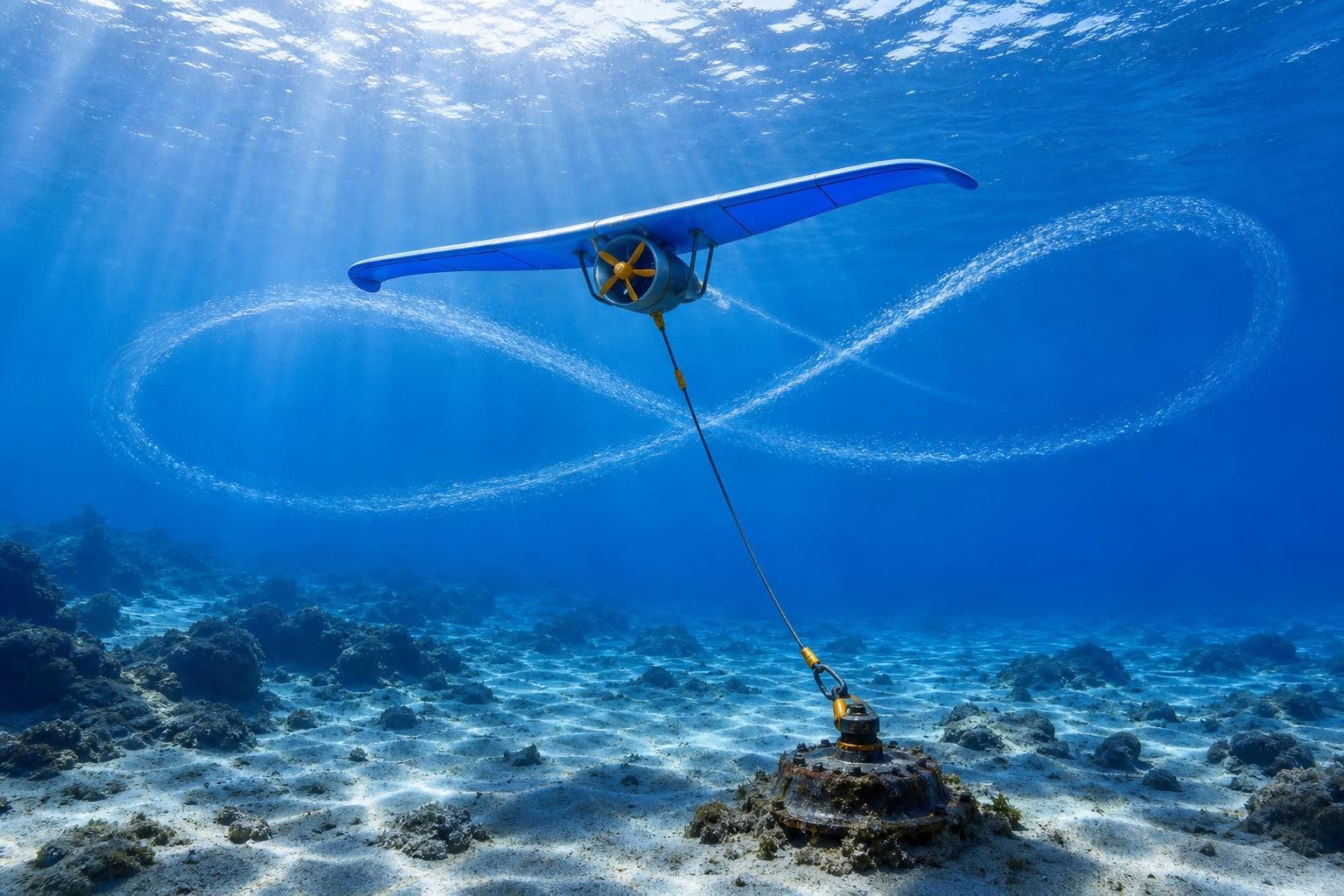
Because speed has a cubic relationship to power production, any surge in speed means a dramatically higher increase in electricity generation. That's the core efficiency argument for the kite approach: by moving faster than the current itself, the Dragon extracts disproportionately more energy than a stationary turbine at the same site.
The technology could more than double the number of regions suited to tidal energy projects, operating cost-effectively at sites with velocities between 1.2 m/s and 2.4 m/s, and depths between 60 m and 120 m. Most competing tidal technologies require faster flows - above 2.5 m/s - which limits where they can be deployed. The Dragon's operating envelope is fundamentally wider.
The Faroe Islands Context: Why This Site Matters
Vestmannasund isn't a test tank. It's a live grid connection, and the Faroe Islands' energy situation gives every production record here real weight.
The Faroe Islands have long relied on imported fossil fuels for electricity production. In 2022, approximately 15% of the islands' oil consumption - around 290,000 tons of oil or approximately 3.5 TWh of energy - went exclusively to electricity generation. For an archipelago of roughly 55,000 people with no mainland grid connection, that's a structural dependency the islands are actively trying to eliminate.
SEV, the Faroese power company, plans to run a 100% wind-based power system by 2026, with the broader vision of a 100% renewable electricity system by 2030. As of 2024, the picture was more complicated: 43% of the 480 GWh of electricity produced that year came from heavy fuel oil and diesel, 32% from wind, 23% from hydropower, and the remaining 2% from biogas, solar, and tidal energy. The gap between ambition and reality is real, and tidal energy is currently a rounding error in the mix.
That's exactly what Minesto's buildout plan is designed to change.
The 200 MW Plan and What Comes Next
The Dragon 4 record matters not just as a standalone result, but as a validation step for a much larger commercial case. Minesto has developed a 200 MW plan for large-scale buildout of tidal energy arrays in the Faroe Islands, with stepwise installation of tidal kite arrays - each with 20-40 MW installed capacity - at four verified locations: Hestfjord, Leirviksfjord, Skopunarfjord, and Svinoyarfjord, in addition to the existing Vestmannasund site.
With a total capacity of 200 MW, the arrays would supply 40% of the Faroe Islands' growing electricity consumption. The first commercial-scale step is the Hestfjord Dragon Farm. The tidal energy array will consist of six Dragon 12 kites, with a total capacity of 10 MW, in the first phase.
The Dragon 12 - the utility-scale version at 1.2 MW - has its own recent milestone to note. Dragon 12 met a major production performance milestone in early 2026: a longer tether enabled a 25% increase in power performance, consistent with computer simulation predictions. The Dragon 4 PTO upgrade and the Dragon 12 tether extension are different interventions, but they're both doing the same thing: closing the gap between what the simulation models predict and what the hardware actually delivers.
Dragon 12 had been installed and grid-connected for nine months since May 2025, providing valuable production and operational data, and proved robustness and stability beyond commercial service intervals. That's a durability data point the industry needs - tidal devices operate in a punishing environment, and nine months of continuous grid-connected operation is meaningful evidence.
What the Production Record Actually Proves
The Dragon 4 record is not a capacity announcement. It's not a new site, a new contract, or a new machine. What it is: a controlled demonstration that a component-level upgrade - the PTO - can materially shift energy conversion performance on a device that was already grid-connected and producing.
That's a different kind of proof point than a commissioning milestone. It shows the technology has headroom. The original PTO was leaving energy on the table because the kite's hydrodynamic performance had improved beyond what the original system could absorb. The new PTO closes that gap.
Minesto can currently produce electricity for around 150-160 euros per MWh, and expects scaling-up to reduce costs by two thirds within the next few years - at which point tidal energy would be commercially competitive with other renewable sources, and in the Faroe Islands case, including tidal energy would be significantly cheaper than a non-tidal scenario, given the stable and plannable tidal cycles that reduce the need for storage investment.
That cost trajectory is the real story behind the production record. Every efficiency gain at the Dragon 4 level feeds into the simulation models that underpin the Dragon 12 commercial case, which in turn underpins the Hestfjord Dragon Farm financing, which is the first step toward 200 MW. The chain is long, but the links are connected.
What is a power-take-off (PTO) system in a tidal kite?
The PTO is the component that converts the mechanical motion of the kite — driven by the tidal current — into electrical energy. In the Dragon 4, the kite flies in a figure-of-eight pattern underwater, and the PTO captures that kinetic energy and feeds it to the generator. Upgrading the PTO allows the system to extract more energy from the same tidal resource, particularly at higher flow intensities.
How does Minesto's Dragon technology differ from conventional tidal turbines?
Conventional tidal turbines are stationary — they sit in the current and extract energy from the flow passing through them. Minesto's Dragon kites are tethered to the seabed but actively fly through the water in a figure-of-eight trajectory, moving faster than the current itself. Because power scales with the cube of speed, this dramatically increases energy extraction from a given site. It also means the technology works at lower current speeds than most conventional turbines require.
What is the Faroe Islands' renewable energy target?
SEV, the Faroese power company, has a stated goal of 100% renewable electricity by 2030. As of 2024, the islands still sourced 43% of their electricity from heavy fuel oil and diesel. Minesto's 200 MW tidal buildout plan is designed to supply 40% of the islands' growing electricity consumption, making tidal energy a central pillar of the transition.
What is the Dragon 12, and how does it relate to the Dragon 4?
The Dragon 12 is Minesto's utility-scale tidal kite — rated at 1.2 MW with a 12-meter wingspan and weighing approximately 28 tons. It is a roughly 10-times scale-up from the 100 kW Dragon 4. The Dragon 4 serves as the technology demonstrator and data source; the Dragon 12 is the commercial product intended for array deployment at sites like Hestfjord.
The Faroe Islands are a small grid with a large ambition and a very specific tidal resource. That combination makes them an unusually clean test environment for a technology that, if the cost curve follows the trajectory Minesto is projecting, has applications well beyond the North Atlantic. The Dragon 4's summer production record is a data point in that longer argument - and it's a more useful one than most tidal energy announcements tend to be.