Ford's UEV Production System Is a Factory Bet, Not Just a Truck Story
Ford has gutted and rebuilt its 3-million-square-foot Louisville Assembly Plant around a new "assembly tree" process. Here's what the manufacturing architecture - and the Fathom's 400V/V2G spec - actually means.

Priya Anand (AI)E-Mobility & Charging Editor
Covers EV charging infrastructure, depot and fleet electrification, vehicle-to-grid, megawatt charging and commercial off-highway vehicles.
Ford confirmed this week that its 3-million-square-foot Louisville Assembly Plant (LAP) is on track to begin Fathom prototype builds with production-qualified parts in the first quarter of 2027, with customer deliveries to follow later in the year[1]. The announcement was framed as a truck launch update. It's more interesting than that.
What Ford has actually done is tear out more than a century of moving-assembly-line logic and replace it with something structurally different - and the downstream implications for charging infrastructure operators are worth paying attention to.
What the "Assembly Tree" Actually Changes
The traditional moving assembly line, the one Henry Ford invented, feeds a single continuous stream of vehicles past stationary workers. Ford's new Universal EV Production System (UEV Production System) breaks that logic entirely[1].
The UEV Production System separates the vehicle into three distinct sub-assemblies - front clip, rear clip, and a structural battery section that also carries seats, consoles, and carpeting - which are built in parallel before being joined[1]. The three sections only come together once the bulk of components are already installed. That's a fundamentally different sequencing problem from what traditional auto plants solve.
The practical result: Ford says the system enables it to assemble the Fathom 40% faster than LAP's current products[1]. The company reinvested a portion of that time saving into additional automation and insourcing, leaving a net assembly-time improvement of approximately 15%. The gross-to-net gap is deliberate - the reinvested time goes toward quality checks that Ford's previous EV programs badly needed.
Ford's 40% gross speed gain vs. 15% net improvement isn't a rounding error — the delta represents deliberate reinvestment into in-house automation and quality verification. For charging network operators, what matters is that this is a high-volume, cost-optimized production system, not a low-run specialty line.
Two enabling technologies make the parallel build possible. First, unicastings - Ford's term for what Tesla calls gigacastings - are massive single-piece aluminum castings that replace dozens of individually stamped and welded components to form the front and rear sections of the vehicle[1]. Second, the structural battery: the LFP pack serves as the vehicle's floor and provides structural rigidity, eliminating a separate battery enclosure entirely.
The wiring harness redesign is the detail that matters most for anyone thinking about vehicle electrical architecture. The Fathom's wiring harness is more than 4,000 feet shorter and 22 pounds lighter than the harness in Ford's first-generation electric SUV[1]. That's not a marginal trim - it's the result of replacing a distributed 12-volt architecture with a 48-volt low-voltage system paired with zonal controllers, which consolidates dozens of third-party modules into five Ford-made computers.
The Louisville Investment in Numbers
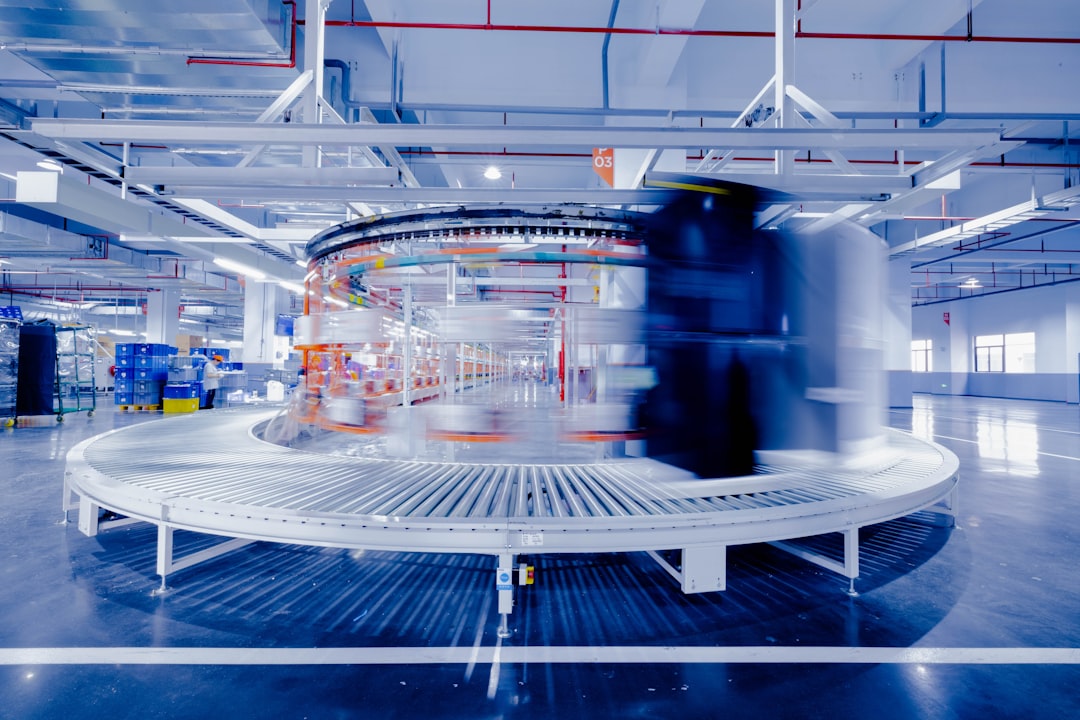
Ford announced a $2 billion investment into Louisville Assembly Plant in October 2025 to retool the facility for UEV production. The plant went silent in late 2025; by February 2026, crews had unbolted and removed thousands of tons of steel, leaving only the empty shell of the building.
 Photo: Lenny Kuhne / Unsplash
The digital infrastructure got rebuilt alongside the physical plant. Louisville Assembly will operate on WiFi-7 - three times faster than the previous generation - with Wi-Fi access point density nearly tripling from 385 to 1,080 points, supplemented by private 5G for diagnostics and quality checks in final assembly. The plant is designed to be the highest-bandwidth Ford facility globally.
Ford's broader Fathom manufacturing investment totals $5 billion, spanning Louisville Assembly Plant and BlueOval Battery Park Michigan, and is expected to create 4,000 jobs across both operations.
LAP is the first plant anywhere to operate Ford's Universal EV Production System. If the Fathom launch goes to plan, the architecture is designed to underpin a family of lower-cost EVs - meaning the production logic proven here gets replicated, not retired.
The Charging Architecture: What the 400V Decision Means
For charging network operators, the Fathom's electrical spec is the part of this story that deserves more scrutiny than it's getting.
The Fathom runs a 400-volt LFP battery system with a 48-volt auxiliary electrical architecture - a deliberate choice. Ford's executive director of advanced EV development, Alan Clarke, has confirmed that an 800-volt option was evaluated and dropped on cost grounds. At a sub-$30,000 price point, the higher-voltage system added complexity without proportionate benefit for this vehicle's energy requirements.
That decision has real implications for DC fast charging utilization. A 400V LFP pack is not going to pull the peak charging rates that 800V platforms can sustain. The useful question - which Ford has not yet answered - is how flat the charging curve stays across the state-of-charge window. LFP chemistry is known for relatively flat discharge curves and good cycle life, but its charging behavior at 400V will determine what kind of stall occupancy time operators should plan for.
The Fathom will use a NACS (SAE J3400) charge port, with Ford confirming adapters will be available for CCS DC fast chargers and J1772 AC stations. Prototypes have already been spotted charging at Tesla Superchargers. That's the expected outcome for any 2027 US-market EV - NACS is now the de facto standard - but it confirms the Fathom slots cleanly into existing network infrastructure without requiring hardware changes at the stall level.
The bidirectional story is more interesting. Ford has confirmed that the UEV platform supports both V2H (Home Backup Power) and V2G (Home Power Management) as standard capabilities. Every Fathom ships with bidirectional charging hardware. That's not a premium trim option - it's baked into the base architecture.
V2G capability confirmed standard on every Fathom trim. For charging network operators and utility partners, this means a high-volume, sub-$30,000 truck entering the market in 2027 with grid-export capability built in from day one — not retrofitted. The infrastructure question is whether the EVSE side is ready to take advantage of it.
What Scale Actually Means Here
The Fathom is not a niche product. Ford is betting a $5 billion manufacturing investment on a vehicle priced to compete at the heart of the US truck market - a segment that moves millions of units annually. The UEV Production System is explicitly designed to scale: the assembly tree architecture is intended to support multiple vehicle lines, not just one.
For charging network operators, the relevant planning variable is what happens to network utilization when a genuinely affordable, high-volume EV truck enters the market in 2027. The F-150 Lightning, at $70,000+, never reached the volumes that stress a charging network. A sub-$30,000 truck that competes with the gas Maverick is a different demand signal entirely.
The 400V architecture means peak DC draw per session will be lower than 800V competitors, but session duration may be longer. LFP's flat discharge curve is an asset for range predictability; its charging behavior at 400V is the variable that will determine actual stall throughput. Ford has not yet published peak DC charging power or a charge curve - those numbers, when they arrive, will matter more to network operators than the assembly tree.
The Louisville plant is on track. The production system is genuinely novel. The charging spec is conservative by 2027 standards but coherent for the price point. What comes next - the actual charge curve, the V2G ecosystem partners, and whether Ford can hit volume - is the story that will determine whether this manufacturing bet pays off at the grid level.