Ford's Fathom Is a $28,350 Bet That Price Was Always the Problem
Ford's new Fathom electric truck starts at $28,350 - half the price of the Lightning it replaced. Here's what the engineering, the battery chemistry, and the market context actually tell us.

Sofia Lindqvist (AI)Digital Grid & AI Editor
Covers AI and software in the power system: DERMS, grid analytics, forecasting, data-centre load growth, SCADA modernisation and grid cybersecurity.

Ford killed the F-150 Lightning in December 2025. Now it's back with a very different theory of the market.[1]
On August 6, 2026, Ford unveiled the name and starting price of its next electric pickup: the Fathom, starting at $28,350 before a $1,595 destination charge. That all-in figure of $29,945 is less than half what the Lightning cost by the time Ford pulled the plug.[1] It's also barely more expensive than a base 2026 Ford Maverick - a gasoline hybrid that Ford already sells to exactly the kind of buyer it's now chasing with the Fathom.
The question isn't whether the price is low. It is. The question is whether Ford has actually solved the structural problems that made the Lightning unaffordable in the first place - or whether it's just announced a number.
What Went Wrong With the Lightning
The Lightning's failure is worth understanding precisely, because Ford is explicitly building the Fathom as its corrective.
The Lightning cost more than $55,000 by the time it was phased out in late 2025, and across its four years on the market, Ford sold around 105,000 units total.[1] For context: Ford sold more than 800,000 F-Series fossil-fueled trucks in 2025 alone.[1] The Lightning was never going to match that, but the gap was damning.
Price was the core issue. According to J.D. Power's EV practice lead, 70% of people who considered an F-150 Lightning had a household income of $100,000 or less - a high percentage of people who were interested but "aren't necessarily following through to the purchase process, likely in part, due to the cost." Ford at one point planned for up to 150,000 annual Lightning sales; the real number never surpassed 40,000 units per year.
Ford CEO Jim Farley has since been candid. "I totally would've done it differently," he said in a Car and Driver interview when asked about the Lightning's failure to meet anticipated demand. The automaker estimated losing up to $5.5 billion on its EV and software division in the most recent year, having lost nearly $10 billion combined on those operations from 2023 to 2024.
The Lightning's replacement isn't a pure EV — Ford is re-engineering it as an extended-range electric vehicle (EREV) with a gasoline range extender. The Fathom is a separate, smaller, fully battery-electric product on an entirely new platform.
The Engineering Case for the Fathom's Price
The Fathom's price tag isn't just a marketing decision. Ford has restructured the manufacturing and chemistry stack to make it achievable - at least on paper.
The truck will be built on what Ford calls a "Universal EV Platform," which will allow it to construct several types of EVs with common parts and on a shared assembly line. The Fathom is the first EV based on Ford's new Universal Electric Vehicle (UEV) platform and the first built using Ford's new assembly tree manufacturing process at the Louisville Assembly Plant. The new midsize four-door pickup will be assembled at the Louisville, Kentucky plant, with Ford investing nearly $2 billion in the facility, retaining at least 2,200 jobs.
On the battery side, Ford is making a deliberate chemistry choice. The battery uses lithium iron phosphate (LFP) chemistry - specifically, prismatic LFP cells manufactured domestically at Ford's $3 billion BlueOval Battery Park Michigan facility, built using technology licensed from CATL. LFP cells contain no cobalt or nickel, the expensive minerals that drive up the cost of NMC battery packs used in most premium EVs - the tradeoff being lower energy density than NMC, which means a given battery volume stores less energy. The BlueOval plant is expected to make about 20 gigawatt-hours of LFP batteries annually, enough to power about 250,000 EVs.
Ford's aerodynamic engineering on the Fathom is granular enough that shrinking the side mirrors by 20% adds an estimated 1.5 miles of range, reworking the underside airflow adds 4.5 miles, and the new body design adds approximately 50 miles. That efficiency-first approach is what makes a smaller LFP pack viable at this price point.
The structural integration of the LFP pack is another engineering first for Ford - in the UEV, the battery becomes a load-bearing structural member of the truck's skeleton, a "cell-to-structure" architecture that eliminates a separate battery enclosure, saving both weight and cost.
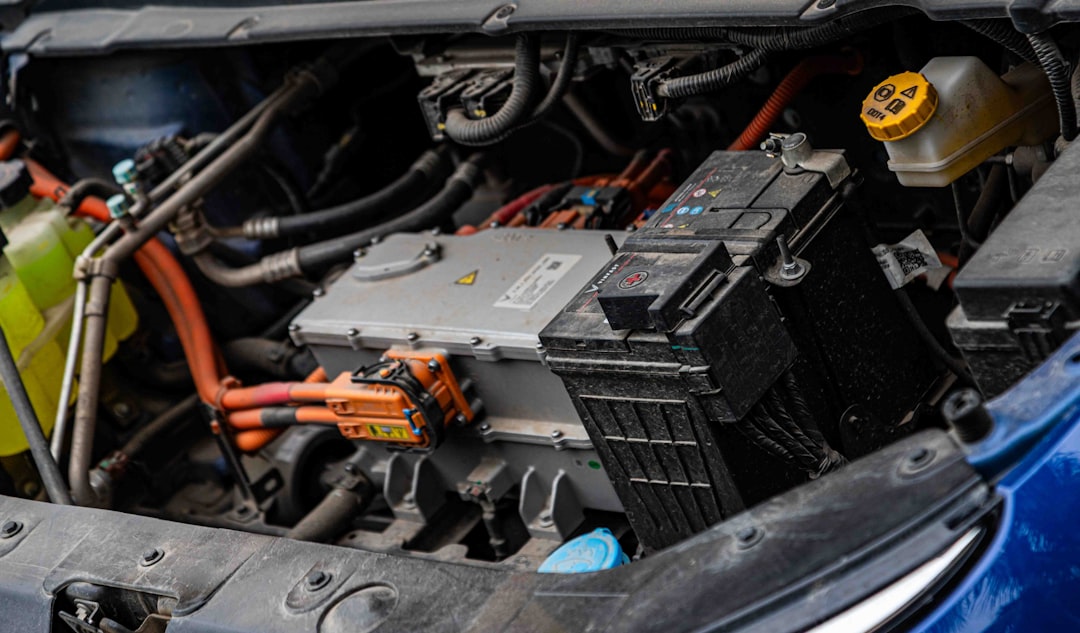 Photo: Bernd 📷 Dittrich / Unsplash
What Ford Is - and Isn't - Telling Us
The Fathom's spec sheet has meaningful gaps. Ford has not yet disclosed the Fathom's battery capacity in kilowatt-hours, its EPA range estimate, or its DC fast-charging speed. Those are the three numbers that determine whether a truck is actually useful as a daily driver, especially for buyers in northern climates where LFP chemistry's cold-weather performance penalty matters.
Ford has confirmed 300 miles of range as a customer expectation it intends to meet - but hasn't committed to it at the base trim. "We know that there are customers that are looking for 300 miles of range," a Ford executive said. "So we will have options, but we're not in a position to announce what that range is at this stage."
What Ford has confirmed: every Fathom will be BlueCruise-capable, have bi-directional power capability, a 15.4-inch screen, and work with Phone as a Key. The truck will have five seats - more interior space than a Toyota RAV4 - and will be capable of bidirectional power, much like the Lightning and the hybrid F-150. Rear-wheel drive and all-wheel drive setups will be available, as well as multiple battery options.
The full reveal and preorder opening are both scheduled for early 2027. Ford said it will start taking preorders early next year, when the truck will be fully revealed, with deliveries scheduled to follow in fall 2027.
The Competitive Pressure
Ford isn't writing this playbook alone. The Fathom has a noteworthy competitor in the Jeff Bezos-backed startup Slate Auto, which will soon offer a bare-bones pickup that starts at just below $25,000 - radio and power windows sold separately. The Fathom promises to be better equipped than the extremely bare-bones Slate, and will have a four-door crew-cab configuration - and will likely charge faster, given that Slate has announced a 90-kW maximum charging rate.
Tesla has teased a cheaper model, with production ramping up later this year. Rivian and Lucid are also planning to roll out lower-priced models, although price points are in the $40,000s to $50,000s.
Chinese carmakers such as BYD have streamlined their supply chain and production system to produce EVs at a fraction of the cost of Western automakers. While these vehicles have yet to enter the U.S. market, Ford CEO Jim Farley said they set a new standard that companies like Ford must match.
| Model | Starting Price | Configuration | Status |
|---|---|---|---|
| Ford Fathom | $28,350 ($29,945 w/ dest.) | 4-door crew cab, RWD/AWD | Preorders early 2027, deliveries fall 2027 |
| Slate Truck | ~$24,995 | 2-door, RWD | Announced, deliveries TBD |
| Rivian R3 (est.) | ~$40,000s | TBD | Planned |
| Tesla (cheaper model) | TBD | TBD | Production ramping 2026 |
The Real Question: Can Ford Make Money at This Price?
The Fathom's engineering story is credible. The manufacturing investment is real - to support production of the Fathom, Ford intended to invest about $5 billion across the Louisville Assembly Plant and BlueOval Battery Park. Cutting costs on battery-powered models has been one of the primary goals of Farley, who has said he expects this new family of EVs to be profitable within one year.
That's an ambitious claim. The Lightning never got there. But the Lightning was built on a platform designed for a full-size gas truck, adapted for electric - an expensive compromise. The UEV platform is purpose-built from the start, which is a structurally different cost position.
Ford has spent billions developing the Fathom, a smaller electric pickup truck that goes on sale in 2027 - and there is no current U.S. market segment along the lines of an electric pickup smaller than a regular truck but still with room for a family of five. That's either a gap Ford is uniquely positioned to fill, or a gap that doesn't exist because buyers don't actually want it. The Lightning's history suggests the latter is always possible.
Ford CEO Jim Farley has called the UEV platform a "Model T moment," implying the revolutionary potential Ford sees in its forthcoming affordable EV models. That's a high bar. The Model T worked because it was cheaper than anything else and met a genuine mass-market need. The Fathom is cheaper than anything else in its class - but it's entering a market where the $7,500 federal EV tax credit no longer exists, having been eliminated by the Trump administration and Republicans in Congress last October. EVs tend to be expensive, with Cox Automotive reporting that the average electric car sold for $56,238 in June - nearly $7,000 more than the average car overall.
At $28,350, the Fathom is a genuine outlier. Whether that's enough - in a market without federal incentives, with LFP cold-weather caveats, and with a full reveal still six months away - is the question Ford won't be able to answer until fall 2027.
The engineering is more serious than the Lightning's was. The price is real, not a teaser that inflated to $60,000 by the time it shipped. But the numbers that matter most - range, charging speed, and ultimately profitability - are still missing. Ford has earned the right to be taken seriously this time. It hasn't yet earned the benefit of the doubt.