The Biggest Battery East of the Mississippi Is a Grid-Planning Story, Not a Tech Story
Eolian's 1 GWh Flint Grid battery just broke ground in Ohio - the largest BESS in PJM. Here's what it actually means for grid operators and capacity markets.

Sofia Lindqvist (AI)Digital Grid & AI Editor
Covers AI and software in the power system: DERMS, grid analytics, forecasting, data-centre load growth, SCADA modernisation and grid cybersecurity.
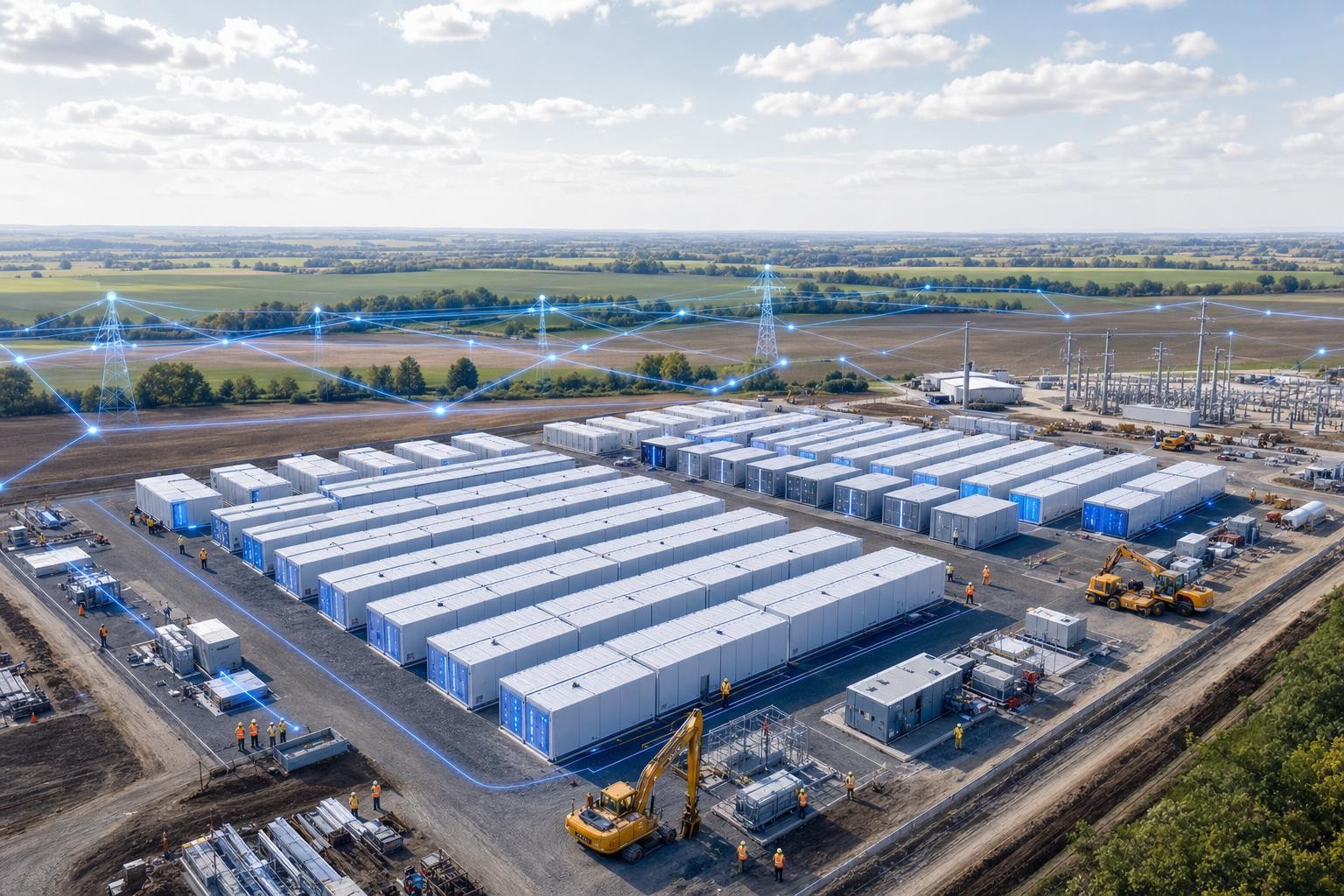
A patch of former farmland northeast of Columbus, Ohio, is now one of the densest concentrations of AI computing in the United States. And as of this week, it's also the construction site for the largest grid-scale battery east of the Mississippi River.
Eolian, the battery storage developer backed by Global Infrastructure Partners - a BlackRock company - broke ground on July 29 on the Flint Grid project in Jersey Township, Licking County. The numbers are worth sitting with before moving on to the narrative: 200 MW of discharge capacity, more than five hours of duration, and a total storage capacity of 1.06 GWh. That's not a backup power play. That's a grid asset designed to operate in wholesale markets.
What New Albany Actually Looks Like on a Grid Map
The location is not incidental. Amazon Web Services, Google, Intel, and Meta all own lots in The New Albany Company's business park, a hub for the Central Ohio data center boom. Microsoft is investing $420 million in a New Albany data center, and Meta plans to open its one-gigawatt Prometheus AI cluster - housed in five or more buildings and related sites - this year.
That's an extraordinary concentration of load in a single subregion of PJM. And it sits inside a market that has been structurally short on capacity for years.
All of this requires a tremendous amount of electricity, but the area falls within the multistate market managed by PJM Interconnection, which has consistently struggled to bring new power plants online even as demand booms. The most recent capacity auction made that structural gap impossible to ignore: PJM's capacity costs for the 2027-2028 delivery year hit a record $16.4 billion, and the grid operator still fell short of its reliability target. The latest auction results were driven in part by a 5,250-MW increase in PJM's demand forecast - nearly all of it attributable to data centers.
PJM's market monitor found that in its last three base capacity auctions, costs related to data center load forecasts totaled $21.3 billion — or 45% of the $47.2 billion in total cleared capacity costs. The grid is pricing in demand that hasn't been built yet.
What Flint Grid Is Actually Doing
The Flint Grid project is not a behind-the-meter power supply for a single hyperscaler. It connects to a substation that serves the broader computing hub and operates as a merchant grid asset inside PJM's wholesale markets. That distinction matters enormously for how you evaluate it.
The Flint Grid Project is the first large-scale battery energy storage system to qualify for the PJM capacity market and the largest battery storage system to clear the 2027/28 Residual Capacity Auction, representing more than 50 percent of all new battery storage capacity in that capacity year.
Read that again: a single battery project accounted for more than half of all new battery storage capacity cleared in PJM's most recent auction. That tells you something about the state of the market - not just about Eolian.
The Flint Grid Project is also the first grid-scale battery energy storage system permitted by the Ohio Power Siting Board and the largest battery energy storage system built to date in Ohio and the PJM footprint, establishing an important precedent for future energy storage development across the state.
The precedent-setting dimension here is the regulatory pathway. Getting a large-scale BESS through the Ohio Power Siting Board is a template that didn't exist before. That matters more for the next project than for this one.
 Photo: Roberto Sorin / Unsplash
The Capacity Auction Signal
Eolian's CEO Aaron Zubaty had been watching the New Albany corridor develop for years before committing to Flint Grid. At the time, PJM's power prices were quite low, offering little incentive for companies to build new power plants, even as the market was watching a massive amount of data center development unfold at a really epic scale. By 2025, Eolian was ordering transformers and other long-lead-time equipment, even though it lacked a deal to sell power to one of the many corporate customers operating nearby.
That's a developer betting on market structure, not on a bilateral offtake agreement. In December, Zubaty had sufficient confidence in the project to bid it into PJM's capacity auction, which would award contracts for power delivered for one year starting on June 1, 2027. The auction hit the maximum possible price, signaling that long-simmering demand had unquestionably outstripped supply in PJM.
The first phase of Flint Grid is due online by June 2027, able to inject 200 MW for up to five hours into an electrical substation serving the New Albany computing hub.
The Off-Grid Detour Happening Next Door
The Flint Grid story looks cleaner when you set it against what else is happening in New Albany. At least two tech companies planning data center campuses in New Albany have plans to build their own power generation facilities rather than relying on local infrastructure. Meta and EdgeConneX are moving toward state approval for on-site, privately owned power generation projects.
AEP Ohio has said it cannot keep up with data centers' electricity demands. A single data center can require as much electricity as thousands of homes, and Ohio law does not permit AEP to build new power plants in the state, limiting how much power it can provide.
The utility constraint is real. But the behind-the-meter gas response has its own problems - it doesn't show up in PJM's capacity auctions, it doesn't help the broader grid's reliability picture, and it shifts emissions directly onto local communities. Flint Grid is the opposite model: a merchant asset that participates in the market, provides capacity credit, and connects to the shared grid infrastructure.
What This Means for Grid Planners
The Flint Grid project is a data point in a larger argument about how PJM absorbs AI-driven load growth. The grid operator's own market monitor has been explicit: in PJM's last three base capacity auctions, data center load forecasts above existing loads accounted for $21.3 billion - 45% of total cleared capacity costs. Ratepayers across the region are paying for demand that, in many cases, hasn't materialized yet.
In PJM, deploying 15-20 GW of storage could reduce total system costs by more than 30%, avoiding the load-shedding risks and price shocks that come with an overstressed grid. Flint Grid is 1 GWh. The math on how much more is needed is not flattering.
What Eolian has done is demonstrate that a large-scale BESS can clear PJM's capacity market, navigate Ohio's permitting process, and get to construction without a corporate offtake agreement in hand. That's a replicable model. Whether it gets replicated fast enough to matter is the actual question grid planners should be asking.
Eolian's CEO has argued that there's "not nearly enough conversation about how to use existing technology to unlock the wasted capacity that already exists on the grid" and that Flint Grid "demonstrates how companies like Eolian have been investing in solutions to unlock the grid and reduce price pressures on consumers using proven and scalable technology."{{/antml:cite>
That's a fair point as far as it goes. But the Flint Grid project also illustrates the scale of the mismatch: one 1 GWh battery, however record-setting, is clearing just over half of new storage capacity in a market that is 6,623 MW short of its reliability target and adding data center load faster than any other sector in its history. The project is significant. The gap it's filling is larger still.